‘Things couldn’t be better’

Try tearing down some walls. You’ll be amazed at what you find. Illustration from 3six5daysoflove.blogspot.com.

Many years ago, when I first came to Washington to work as a newsletter editor, I got to know my printer’s sales representative pretty well. Don was perpetually chipper. If you asked him how things were going, he would always say, “Things couldn’t be better.”

Regardless of what was going on, he was always upbeat. I asked him one day whether anything ever bothered him. Surely he must have his share of bad days, just like everyone else.

He gave me an explanation that I still remember and have found myself employing in social situations: “Jay, no one wants to hear about your problems. When you’re in sales, you have to give the customer the impression that you’re on top of the world, that you couldn’t possibly be more successful—even if you’re not.”

Yes, and how many times have you been at a networking event and the conversation goes something like this:

“Bob, good to see you. How’s it going?”

“Great! How about you?

“Super!”

“Glad to hear it! Jay, I’ll catch up with you later. Great seeing you!”

This past weekend, I was thinking about how superficial our interactions can be compared to…prison life. Prison life? Let me explain.

I am involved in a prison ministry called Kairos, and last week we were working with inmates to help them tear down the psychological and spiritual walls in their lives. Prisons are not a fun place, and you have to act tough to survive. For most guys, acting tough starts long before they land in jail. Their walls go up in childhood, defense mechanisms that keep out feelings of insecurity, insulate against abuse and substitute for love. Walls can protect you, but they also isolate, alienate and dehumanize in an environment that is starkly devoid of genuine interaction and caring.

Ironically, the inmates who have gone through the Kairos program live more freely than those of us on the outside who work with them. They’ve managed to tear down their walls and create a community built on respect, honesty, trust and love. It is the most extraordinary, powerful and positive force I have ever encountered—and it’s inside a jailhouse.

Kairos has at its heart the love of Christ (and in our view, you can’t top that); but said in a more secular way, it’s about the power of vulnerability.

It’s interesting that vulnerability is now recognized by management experts and executive coaches as one of the hallmarks of great leadership. Quite simply, making yourself vulnerable shows you are human. It fosters connection, sharing and communication. And if you create a safe place where your employees feel they can let down their guard, if only momentarily, think about how those silos and walls can come tumbling down. Think about how productivity can go up because people are actually cooperating.

Vulnerability is not weakness. It is not about making excuses or ignoring the consequences of our actions. Viewed through the lens of servant leadership, vulnerability is actually power. As Keith Rosen writes in “Showing Vulnerability Can Make You a Stronger Manager, “While it may sound counterintuitive, it’s a leadership paradox; being vulnerable does not equate to weakness but to greater strength. When you embrace your humanity and express your vulnerabilities, you become a fearless and invincible leader.”

So the next time someone asks how you’re doing, why not open up a little? You don’t have to whine, cry or throw a pity party—just share and listen. You’ll be amazed at what happens.

Check out this TED Talk to learn more about vulnerability:

Posted in Leadership, Purpose | Tagged , , , , | 2 Comments

How many of these 10 habits are you passionate about?

My thanks to David Kanigan at Lead.Learn.Live. for putting me onto an excellent piece by M.A. Tohami called “The 10 Habits of Passionate People.” It caught my eye because last week I wrote that being passionate is one of the things you absolutely need to do to make it as an indie.

From David Kanigan’s blog, Lead.Learn.Live.

I don’t know how many of these 10 you are doing, but like David, I come in around 7.5. On a couple of these, I am way underwater. I have never been an early riser, and I’m only a reluctant exerciser. Those are my two main deficiencies, but I am working on them.

I noticed Tohami has a note about Thomas Jefferson rising with the sun. Being a graduate of Mr. Jefferson’s University (U.Va.), I do remember reading somewhere that no matter what time he went to bed, he was always up by sunrise. Yes, but did he take naps? That’s the question.

I totally agree with Tohami’s point about the importance of networking with other passionate people. There is nothing worse than going out with coworkers and bellyaching about everything that’s wrong at the office. While some venting is probably healthy, I would suggest you extricate yourself from those situations as quickly as possible. Listening to and engaging in negative talk is a big time-waster and only detracts from your passion.

I was also pleased to see that Tohami is a fan of blogs. For those who have asked me from time to time why I do this crazy thing called blogging, he says it better than I could:

Have a Blog

“Blogs are much more powerful than most realize. They’re a simple way to explore and share the thoughts and beliefs you’re excited about and for people to immediately see and provide feedback.” – Scott Dinsmore of Live Your Legend

A blog is a multimedia platform through which you can share your passion with the world in text, audio or video formats. People can come read, listen or watch you delivering your value. And if they like what you do, they will share it with their friends and the community will grow.

It is also a perfect way to practice and share your passion with the world on a daily basis. It ensures a constant strong bond between you and your passion.

So give some thought to taking the blogging plunge. You’ll find the water’s just fine.

Posted in Goal setting, Purpose | Tagged , , , , , | 4 Comments

8 things you absolutely have to do to make it as an indie

“Good news, they liked your proposal. But can you get the project done by tomorrow?”

Seven months into my new life as an independent public relations practitioner, and I am still learning every day. But even a slow learner like me can see that these eight things make all the difference in the world. I’m not saying that I do all of them, but at least I know I should. See how many you’re doing in your business.

1. Take charge – You always said you could do it better. Well, now’s your chance to prove it, my friend. That means you have to step up to the plate. No hanging back. Make the calls you need to make. Put together the proposals you know can land the jobs. Do the work you were born to do! Don’t wait to be asked, don’t hesitate to deliver, don’t waste time wondering about what could have been. No excuses. Just do it!

2. Be passionate – Have you ever known any successful business people who aren’t passionate? Not 100% totally committed to their product, brand or company? ‘Nuff said. Sure, passion alone doesn’t move mountains, but it helps. Clients like people who get excited about their work. It’s contagious, so go out there and spread some passion.

3. Manage thyself – You don’t have to be a CPA, but you do need to keep track of your expenses and your income. Set up a business checking account. Keep a spreadsheet and record those trips, lunches and events you attend. Yeah, it’s busy work, but you gotta do it. But more importantly, you’ve got to manage your time. Time is sneaky. Just when you least expect it, time will sucker-punch you. It will sap your day, leaving you with a dead battery and no AAA in sight. Don’t waste time, ever. Get stuff done early in the day. Make a schedule, and stick to it.

4. Market every day – This is the key: You’ve got to sell yourself everyday. It doesn’t come naturally, at first. But then, if you make it part of your daily routine, you start to surprise yourself by how good you are at it. PR people, you can do this! You’ve got the talent, you know how to communicate. Now just start directing it at future clients.

5. Think big – No more silos because it’s just you. Any barriers now are the ones inside your head. Show people you are capable of thinking outside the box. Show the marketing director you know the market. Show the CEO you know her industry. Show the small business owner you’ve got ideas to revitalize his business. Don’t be afraid to step outside your comfort zone. Don’t be afraid to dream big—for your business and yourself. You’ve got imagination and determination, now go use it.

6. Stop doubting yourself – Get over your fears, and wipe away the self-doubt. Believe in yourself, man. Surround yourself with supporters; don’t let the naysayers get you down. Listen to motivational CDs if it helps. Read books. Talk to people who’ve been there. Savor the small victories; then move on, setting new targets.

7. Don’t go it alone – You really can’t do it by yourself. And if you tried, you’d go crazy. Join groups and network. Accept the advice and help of others. Stay in touch with what’s happening in your profession, but always reach beyond your circle to make new connections.

8. Be flexible – Lot’s of peaks and valleys in this business, so roll with it! Clients take time to develop. Learn to gently prod, to follow up, to remind them that you exist. At the same time, learn to use your downtime wisely. Do some marketing. Update your website. Heck, write a blog post!

Posted in Careers, Entrepreneurship, Getting started | Tagged , , | 2 Comments

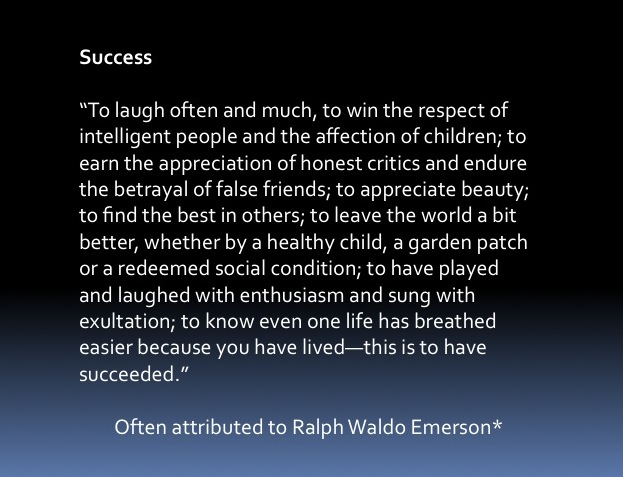
Maybe success is ‘living meaningfully well’


When I embarked on the Wayward Journey last September, I dreamily contemplated a sabbatical of self-examination, writing and study, coupled with starting my own business. I looked at my time in much the same way, I suppose, a college professor optimistically expects to finish a book, travel and do research over summer break—only to find the days slipping away, and soon it’s August and many of the things on his list haven’t been accomplished.

But what is the measure of success? Is it productivity? While I have accomplished much on my list over the last seven months, I’m not sure the guy with the most items checked off wins in the end.

I was on a website recently called “Joy of Quotes” that had hundreds of quotes from famous people about success. Not a single one talked about the little things I get bombarded with every day in my working life: how to increase search engine optimization, get more media placements, increase e-mail open rates, better manage my time. That is, nothing about “more, more, more.”

Rather, most successful people talked about fulfillment, helping others and understanding that failure often is a precursor to success. Failure is not something that many of us aspire to, of course. But in fact, the fear of failing is what keeps us from not trying and, in essence, prevents us from ever succeeding.

One of the great lessons in life is that until you let go of your fears, drop your petty concerns and give up your selfish ways, you are never going to be truly happy or successful. It’s that letting go part that is the hardest. I have often wondered about the New Testament story of the rich man who asks how he might enter the kingdom of God. When Jesus tells him he must sell everything he owns and follow him, the man is crestfallen and goes away. Jesus then says that it would be easier for a camel to go through the eye of a needle than for a rich man to enter heaven. That’s how hard it is for us to give up our constant desire to own and do more. And yet, every great leader (and parent) understands that in the act of giving up everything—sacrificing yourself—you actually succeed big time.

I’m an admirer of the work of Umair Haque, director of Havas Media Labs and a regular blogger on the HBR Blog Network. He writes about creating a new kind of economy that is less concerned with consumption and more concerned with human well-being. He calls it an “eudaimonic” economy, after the Greek philosophical term for “highest human good.”

His HBR post from May 2011 (“Is a Well-Lived Life Worth Anything?”) really makes you think. “Eudaimonic prosperity,” he says, “is about mastering a new set of habits: igniting the art of living meaningfully well. An active conception of prosperity, it’s concerned not with what one has, but what one is capable of.” Among the key attributes he ascribes to Eudaimonia:

  • Living, (working, and playing) not just having.
  • Better, not just more.
  • Becoming, not just being.
  • Creating and building, not just trading and raiding.
  • Depth, not just immediacy.

In a more recent post, “You Don’t Need This ‘Recovery,'” Hague calls on each of us to engage in a “tiny revolution.” He’s a masterful writer. I’ll leave you with just one paragraph, but there’s plenty more:

I don’t want a revolution. I want a million tiny revolutions. Revolts not merely against, but for, towards, into. In a cold universe, nothing matters more than a tiny spark of life; living fully, wholly, incandescently, not merely “happily,” but full of significance, infused with belonging, rich with meaning, seared with love, spent with grace, consumed with purpose, hinting at the closest you and I have to a truth: none of us will be forever. But each of us is right here, right now.

* Source of “Emerson” Success quote: While I love this quote widely attributed to Emerson, The Ralph Waldo Emerson Society says Emerson never said it. In fact, it is a variation on the writing of one Bessie Anderson Stanley and appeared originally in an anthology of quotes published in 1904. Sometimes you’ll see the quote (mis)attributed to Robert Louis Stevenson (thank you, Hallmark, for that one). BTW, the University of Virginia (my alma mater) asked its Arts & Sciences graduates to send in their definitions of success and published them here. The “Emerson” quote is included, but at least the grad submitting it noted it is “attributed” to Emerson. This is the difference between a regular college education and one at U.Va., where we are trained to be scholars and seekers of truth. 🙂
Posted in Leadership, Purpose | Tagged , , , , , | Leave a comment

I’m no Alton Brown, or 7 lessons learned from (not) cooking

Sure, I’ve been known to watch the Food Network, but that doesn’t mean I’m a foodie. And while it’s true I once worked for the National Restaurant Association, I’m far from a restaurant critic.

The fact is, my taste in food and my culinary skills are about as lowbrow as you can get. When I worked for the NRA in the 1980s, I had the good fortune of visiting some of the best restaurants in America. But I would joke with friends that I was always happiest eating a peanut butter and jelly sandwich.

About the only thing Alton Brown and I have in common is that we both wear glasses.

Left to my own devices, I’ll eat a Hot Pocket and a bag of Cheez-Its. My top choice for breakfast for many years, well into my 40s, was Pop-Tarts. I view the kitchen as the domain of others. I can stir, microwave and check on things, but my biggest contribution is usually washing the dishes.

I once took an adult education class called “Clueless in the Kitchen.” Our teacher was extremely sympathetic towards beginning cooks, and we had a lot of fun learning our way around the kitchen. This spurred me on to take “Northern Italian Cooking.” That proved to be too much too fast. Our instructor was a real chef who expected us to know a lot about cooking. At the beginning of each class, he would give us a quick demo (like here’s how to make pasta from scratch) and then order us to our kitchens. We’d scramble, just like on “Iron Chef,” to make all of the things on his list in the allotted time we had to cook.

I am in awe of those All Star chefs who can whip up a tantalizing dish in just 20 minutes. I love those supercilious judges (the bigger the ego, the better) who say things like, “Your sautéd leather shoe is surprisingly tender, but you didn’t use all of the ingredients. Where’s the okra? I’m not tasting it.”

Watching other people cook all these years has led me to formulate some basic laws of the kitchen that I believe have universal application:

  1. Know your place. If you don’t have a job in the kitchen, stay out!
  2. Respect others. Taste is subjective. Learn to appreciate other people’s cooking. Better yet, just learn to appreciate other people.
  3. Don’t be afraid to try new things. Some of the best things in life are the result of trying new recipes and ingredients.
  4. Comfort food is good for the soul. Sometimes grits ‘n gravy are better than a gourmet meal.
  5. Be a hospitable guest. If someone cooks for you, at least offer to do the dishes.
  6. Extras can make a difference. A good bottle of wine (or two) will do wonders!
  7. Invite someone to dinner. Life is short. Share a meal. It won’t kill you.

Bon appétit!

Posted in Careers, Happiness | Tagged , , , , , , | 2 Comments

Making our way around the Internet

We bloggers often direct our readers to the work of others. In fact, that is the whole point of blogging—to share with each other and create online conversations. I love it when another blogger gets me curious enough about someone else’s website that I want to go there myself and check it out. Often I’m amazed at what I find. And I mean that in a good way.

NAFCU’s redesigned magazine.

Today, I want to shine the spotlight on some other sites where I have been fortunate to have my scribblings published.

The National Association of Federal Credit Unions (NAFCU) has a magazine called The Federal Credit Union (TFCU) that I’m very fond of since at one time I had a hand in it’s publication.

This week, NAFCU unveiled a digital version of TFCU and a fresh new design. Kudos to NAFCU’s Karen Tyson, Rick Taylor and Ioana Dietsch for pulling this off, along with Marcella Drula-Johnston and Andi Harris at Spectrum Creative. It looks great!

I’m pleased to say that my feature story on the future of credit unions is in this issue. If you’re curious about what’s in store for mobile banking over the next 10 years or so, you’ll want to give it a read. Did you know that smart phones will soon eclipse regular mobile phones? That’s how quickly the mobile world is changing. Remote check deposit, which has just been introduced at many financial institutions, will soon be ubiquitous as well. If you want to learn more, read on.

Eleanor Clift at last week’s IPRA meeting.

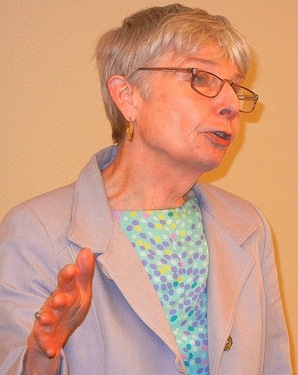
I’ve always been a fan of Eleanor Clift of Newsweek, and so I didn’t want to miss last week’s Independent Public Relations Alliance meeting where she was our guest speaker. My article on her remarks was published yesterday in the Capitol Communicator. Thanks to Phil Rabin, CC’s managing editor, for letting me write this up. And thanks to IPRA’s Vicki Robb for arranging for Clift’s guest appearance at our luncheon. Clift was optimistic that Tina Brown, Newsweek’s new editor, will be able to turn around this iconic publication. I hope she is right.

Finally, I want to thank Jeff Ghannam, a past president of PRSA-NCC, for putting on a great event last month for senior communicators at Carmine’s restaurant. My post on this inaugural gathering went up on the PRSA-NCC blog over the weekend. The biggest thing I liked about the “20+ LeaderPack” is that it allowed us to engage in some genuine relationship building. So often we don’t have time to build real relationships, and I hope these quarterly get-togethers of PR people with 20-plus years of experience will do just that. In addition, it was great to hear from PR professional turned leadership coach and author Kristi Hedges and learn about the career changes she’s made.

If you are interested in Kristi’s recently published book, it’s called “The Power of Presence.” Those familiar with the concept of emotional intelligence (EQ) will find themselves agreeing with her premise that technical knowledge, work ethic and presentation skills don’t put people on the fast track as readily as a compelling presence. Good luck with the new book, Kristi!

Posted in Careers, Leadership | Tagged , , , , , , , | 1 Comment

Celebrating the loss of my late mustache

It’s been a year since I shaved off and unceremoniously washed down the sink a 35-year companion and confidante—my mustache, my friend, my alter ego! What possesses a man to remove something so close (what could be closer?), so much a part of him?

From the photo vault: A study in gray.

After all, my mustache was there when I graduated from college. It stood with me when I got married (and by me when I got divorced). It was there when my son was born. It accompanied me on job interviews and business trips; to restaurants, concerts and sporting events; on camping trips and vacations.

Everywhere I went, my mustache went. There was no separating us! We liked the same things. We had the same friends. We even finished each other’s sentences!

For years, I considered my mustache an improvement to my face. When I was young, it made me look dashing (whatever you say); and as I grew older, it made me look wise (right). But then…something crept between us. I’d look in the mirror and notice the gray. I began to wonder. First it was just a crazy idea to shave it off. A fleeting thought, but it grew and consumed me to the point where I just had to do it.

I did not realize until I Googled “mustache” what a rich treasure trove this subject is. We humans have a lot of feelings tied up in facial hair!

Guy de Maupassant

As you can imagine, given the origin of the word, the French have had much to say about their mustaches. The 19th Century writer Guy de Maupassant wrote a humorous short story called “The Mustache” in the form of a letter from Jeanne, a French lady whose husband has just shaved off his mustache. “I no longer recognize him—by day or at night,” she exclaims. “If he did not let it grow again I think I should no longer love him; he looks so horrid like this.”

According to Jeanne, “a man without a mustache is no longer a man. I do not care much for a beard; it almost always makes a man look untidy. But a mustache, oh, a mustache is indispensable to a manly face.”

Then there is the curious story of “La Moustache,” a French film from 2005 written and directed by Emmanuel Carrère. Described as “a paranoid thriller in the manner of Alfred Hitchcock,” it’s about a guy who shaves off the mustache he’s had for years, but his wife and friends don’t even notice. In fact, they claim he never had a mustache to begin with. This nearly drives him crazy, and ultimately the only thing that brings him back to sanity is to grow back his mustache—then shave it off again at his wife’s suggestion. Go figure!

I can’t say that shaving off my mustache was a “paranoid thriller,” but it was a big decision. I did the deed while on vacation, so the gravity of it weighed on me for a few days before returning to work. Then the questions started. “What made you do it?” For months, people would stop and stare, suggesting there was something “different” about me.

In many ways, the act of shaving it off was symbolic of bigger changes occurring in my life. Some may think it was a sudden, rash decision, but I rather think it had been a long time coming. I don’t plan to grow mine back anytime soon, despite the character Jeanne’s protestation, “There is no love without a mustache!” I have found love without it, and it’s just fine.

Posted in Happiness | Tagged , , , , , | 4 Comments

Hats off to longevity and late bloomers

Barzun

Jacques Barzun. Source: Wikipedia.

I’ve been reading in small doses Jacques Barzun’s acclaimed “From Dawn to Decadence: 1500 to the Present.” I’m lucky if I can wade through more than two pages in one sitting since Barzun’s carefully researched survey of Western history is so densely packed. Like the Bible or James Joyce’s “Ulysses,” you don’t so much read as study this 877-page book.

What amazes me more than the breadth and wit of his writing is the fact that Barzun is now 104 years old. He began work on “From Dawn to Decadence” when he was 84, and it was published in 2000 when he was 92.

I thought I was getting “over the hill”; but compared to Barzun, I’m a mere toddler in Pampers. I say hats off to people like Barzun who continue their careers long after everyone else has called it quits and to those underachievers who, through persistence and hard work, bloom much later in life.

Success seems to be the domain of the fast and young in our culture—star athletes leave college so they can get a head start on their professional careers, and geeks like Steve Jobs, Bill Gates and Mark Zuckerberg drop out of school, too, to make their first billion before the age of 30.

As it turns out, there are many celebrated late bloomers in literature, art and the sciences. Cezanne, Matisse, Edison, Einstein, Hitchcock, Freud, Defoe and Twain are just a few famous people who did some of their greatest work later in life.

It’s no surprise that Susan Boyle’s first audition on “Britain’s Got Talent” has had millions views on YouTube. I get shivers myself when I see her, a dowdy, unknown 47-year-old from a small village in Scotland, taking the stage to sing a soaring rendition of “I Dreamed a Dream” and proving to all of the world that she definitely has talent.

If you’re a late-blooming career-changer like me, take heart. Like Boyle, your time has come. You have the experience and the skills to do great work. And if you’re willing to spend time learning “new tricks” like social media and think outside the box in an entrepreneurial way, I have no doubt you will do well.

As Americans continue to live longer and more productive lives, more people start second careers, and technology makes it easier and less expensive to start a new business, there’s undoubtedly going to be a Renaissance in the self-employed and small business sector.

From_Dawn_to_Decadence

Barzun’s description of the impact of the first wave of printed manuscripts across Europe reminds me of our current age of digital media. The similarities are striking. Think about how for centuries no one except the rich and the clerisy had access to hand-copied books. Suddenly, books and pamphlets are spreading like wildfire—translated into new languages, offering new voices and perspectives, and ushering in new ways of thinking.

The possibilities today are endless with new apps, social media, tablets and e-readers coming out every day. And the cost of producing and acquiring content just keeps going down. As the saying goes, “The world is your oyster.” It’s an exciting time for both young and late bloomers who’ve “got talent.”

Posted in Getting started, Purpose | Tagged , , , | Leave a comment

Hard evidence that soft leadership skills matter

LincolnIt’s interesting that Inc. and the McKinsey Quarterly both had articles this week on what you might call the softer or “emotional intelligence” side of leadership. Geoffrey James’ “8 Core Beliefs of Extraordinary Bosses” on the Inc. website is well worth the read. So is McKinsey’s denser (but still enlightening) article, “Developing better change leaders,” that describes how a large, global industrial company instituted an operations-improvement program across 200 plants worldwide.

James interviewed some of the most successful CEOs in the world and found the “best of the best” shared eight key beliefs. Here are three that I found myself identifying with:

A company is a community, not a machine.
Average bosses
consider their company to be a machine with employees as cogs. They create rigid structures with rigid rules and then try to maintain control by “pulling levers” and “steering the ship.”

Extraordinary bosses see their company as a collection of individual hopes and dreams, all connected to a higher purpose. They inspire employees to dedicate themselves to the success of their peers and therefore to the community–and company–at large.

Management is service, not control.
Average bosses
want employees to do exactly what they’re told. They’re hyper-aware of anything that smacks of insubordination and create environments where individual initiative is squelched by the “wait and see what the boss says” mentality.

Extraordinary bosses set a general direction and then commit themselves to obtaining the resources that their employees need to get the job done. They push decision making downward, allowing teams form their own rules and intervening only in emergencies.

Motivation comes from vision, not from fear.
Average bosses
see fear−of getting fired, of ridicule, of loss of privilege−as a crucial way to motivate people. As a result, employees and managers alike become paralyzed and unable to make risky decisions.

Extraordinary bosses inspire people to see a better future and how they’ll be a part of it. As a result, employees work harder because they believe in the organization’s goals, truly enjoy what they’re doing and (of course) know they’ll share in the rewards.

How many of us have had to work for “average” bosses or, to be brutally honest, have at times resorted to “average” management tactics because we’re afraid to change or feel those are the only tactics that really work?

As McKinsey notes, “Far too often, leaders ask everyone else to change, but in reality this usually isn’t possible until they first change themselves.”

Among the takeaways from the McKinsey article:

  • Leaders shouldn’t overlook the “softer” skills needed to disseminate changes throughout an organization and make them stick, including inspiring workers who may feel overwhelmed by change, and promoting collaboration and dialogue, not dictation.
  • Personal mastery skills that are especially useful in transformation include “learning to recognize and shift limiting mind-sets, turning difficult conversations into learning opportunities, and building on existing interpersonal strengths and managerial optimism to help broadly engage the organization.”
  • Giving managers access to senior-executive sponsors who can tell them hard truths is vital in helping them to change how they lead.
  • Create networks of change leaders across the organization to break down silos.

So given the hard evidence that soft skills are the hallmark of extraordinary leadership (the company McKinsey worked with estimates it boosted annual pretax operating income by about $1.5 billion a year), why are so many organizations still run in a rigid, dehumanizing and change-averse manner?

It’s a good question.

Posted in Leadership, Purpose | Tagged , , , , | 2 Comments