Random thoughts on this fine spring day

camellia

My prized camellia is in full bloom, having staged a miraculous comeback.

What a glorious morning. I watched for a little while as the men laid sod at Debbie’s house. I wanted to go out there and join them as they spread it out like a carpet and trimmed it with their knives. To touch the earth and grass all rolled into a single strip of living, breathing Nature. There’s something about being outside and working the soil. I should have been a nurseryman.

My camellia is in full bloom and larger than ever before. It is now three times the size of the tiny tree that I thought for sure was a goner when I came home from work one day and discovered it totally uprooted and lying on its side. In fact this happened several times before I finally staked it down on all four sides and prayed that it would live. I nursed it back with frequent waterings and fertilizer. And now, well, it’s beautiful. So that’s my garden resurrection story!

Been watering the far backside of my property. Okay, I live in a townhouse, not in the country, but the very back of my little piece o’ paradise is always dry. Seems way too early to be watering, doesn’t it? As I watered, I could hear the hum of my neighbor’s air conditioner. Now, that is just too darn early.

Pulled weeds and cut back roses. Trimmed bushes. Good grief, you’d think it was June.

Found the book “Bearing Fruit” that I had been looking for in a pile papers on my dining room table. What is lost shall be found.

Thought about resurrecting (there’s that word, again) a “mock” gardening column I fiddled with several years ago called “The Anxious Gardener.” It was my attempt at humor. Imagine Woody Allen writing a gardening column—that was “The Anxious Gardener.” Probably better to let it rest. This blog is better.

Put the finishing touches on a feature story for The Federal Credit Union magazine. Working on it has been a joy and a challenge. I have to get it down to 2,500 words, and I am long-winded!

Touched base with Thornell, my contact at Bailey’s Crossroads Community Shelter. Tonight is the last night we host our homeless friends at the church. May they find new life, strength and joy on this fine spring day.

Still let new life and strength upspring,
Still let new joy be given;
And grant the glad new song to ring
Through the new earth and Heaven.

– “The Glory of the Spring How Sweet”

Posted in Happiness | Tagged , , | 1 Comment

Learning to lead and live from David Kanigan’s blog

There are some excellent blogs out there, and one that I highly recommend is Lead.Learn.Live. by David Kanigan. I wouldn’t have known about this wonderful blog if Dave hadn’t taken the time to “like” a couple of my posts. These past few weeks I’ve come to realize that he is not only a perceptive student of life and a prolific synthesizer of wisdom, but he’s incredibly generous and gracious in his support of other bloggers.

If you haven’t checked out his blog, here are excerpts from three recent posts. Enjoy!

Be like Ben (Franklin)…what good shall I do today?

March 2, 2012 By 24 Comments

Benjamin Franklin (1706 – 1790) was one of the Founding Fathers of the US.  He was a noted polymath (def: A person of wide-ranging knowledge or learning), a leading author, politician, musician, inventor, statesman, scientist…bottom line – a genius, this man.

He developed a process of overcoming his bad habits and replacing them with good habits.  He worked on this every single day.  KEEP IN MIND, THIS WAS OVER 290 YEARS AGO. Is it any wonder then, why this man was as accomplished as he was.

I read his process, his approach and his disciplined execution.  Writing down his goals.  Tracking progress daily.  My reaction? I am a Sloth.  [Read more…]

Nothing is small or petty in this life…

February 29, 2012 By 16 Comments

“No man can be happy, efficient, creative at his work when he is unhappy with his situation and lives for another day.  All of us are too prone to postpone our living until some nebulous time when ‘our ship will come in.’  Nothing is so apt to inject dissatisfaction into our lives as this wasteful attitude toward the most perishable of all things we know – time.  Today, this very day, is the most important time of all, for what we do today determines what we will be tomorrow.   Therefore turn all your attention to your labors of the moment, absorb yourself, take your satisfactions from each thing you do, however humble in your mind.  Nothing is small or petty in this life.  The massive door of a vault swings on the apex of a tiny jewel, and men have become great through learning how to do well the lowliest of jobs.”  – U.S. Anderson, Three Magic Words

Life is Color (and 250,000 bouncy balls)…

February 24, 2012 By 19 Comments

Settle in and watch 250,000 colored balls being dropped down Filbert and Leavenworth Streets in one of the world’s greatest cities – San Francisco. [Read more…]

Posted in Purpose, Staying motivated | Tagged , , , | 2 Comments

Putting balance in your life in 7 key areas

How many of us have achieved that elusive balance in our lives—successfully juggling career, family, exercise, learning, volunteering, and faith and spirituality?

balanced stonesIn the 1990s when I worked for the National Association of Insurance and Financial Advisors, I heard about the Million Dollar Round Table’s (MDRT) “whole person” approach to life. I didn’t really pay much attention to it then (I was young); but lately as I’ve tried to put balance in my life and correct a few of my deficits (lack of exercise, for one), I’ve come to better appreciate this whole-person concept.

MDRT is an organization for top producers in the life insurance field, and in 1961 Mortimer J. Adler, the philosopher and educator who started the Great Books Foundation, spoke at MDRT’s annual meeting. He challenged these highly successful agents to live their lives more fully by paying attention to seven key areas: relationships, health, education, career, service, finances and spirituality. To its credit, MDRT embraced Adler’s message and has made the whole-person concept a part of its program ever since.

As MDRT puts it:

With all the demands for your time and attention, it is easy to lose touch with the other equally important aspects of your life—family, community service, health and spirituality. To bring all those elements into balance, many MDRT members have embraced the Whole Person concept.

Living a well-rounded, balanced lifestyle and becoming a Whole Person is the foundation for:

  • Ongoing happiness
  • Loving family relationships
  • Strong friendships
  • Self-confidence
  • Good health
  • Financial security
  • Intellectual fulfillment

MDRT has a quiz on its website that is a great way to see if you’ve got your life in balance. I admit that some of these things I really need to work on. Here are a few of the statements from the quiz where I didn’t do so well:

“I give family and friends my full attention by turning off my phone, BlackBerry, laptop, iPod when I am with them.” Ouch.

“I invest at least 30 minutes in cardiovascular exercise three times per week.” Getting there.

“I have created and regularly review my business plan.” You got me.

“I positively influence the lives of others through formal or informal mentorship.” I need to work on this one.

“I have written financial goals.” Well, in my head.

“I am passionate about leading a life that reflects my strong personal values.” Yes, but I’m not sure I always execute like I should.

Just about every highly successful person I’ve read about reviews his or her goals at least weekly, if not daily. It’s a good routine to get into and reinforces the “right thinking” that is required to change bad habits into positive habits. One of my goals is to exercise daily. I have a habit of sitting in front of the computer way too long.

How are you doing with your goals and putting balance in your life?

Image of balanced stones from building43.com.
Posted in Goal setting, Happiness, Purpose | Tagged , | Leave a comment

Try a little online kindness, it may be contagious

Last week I had the opportunity to hear a number of excellent speakers at several venues. Some were accomplished public speakers who probably have many paid engagements each year. Others were less rehearsed but still quite good. The one that stands out the most, though, was Kevin Fawley of SoMeGo, the luncheon speaker at last Thursday’s Independent Public Relations Alliance meeting in Tysons Corner.

Kevin made an impression because he was, well, different. Speakers at networking functions and professional workshops usually fit a fairly predictable mold. They’re experts in their field, technically proficient, well-connected, but often what they say doesn’t go much beyond a list of how-to’s or sharing examples of what they’ve done for clients. A couple of weeks go by, and you are hard-pressed to remember much of anything they said.

I have to give Kevin credit for shaking things up. Maybe it was his youth (26 years old, according to his blog, Fearless Hustle), his blunt language or the fact that he wore jeans and a polo shirt when the rest of us were suited up, but I really think it was his passion and raw energy combined with a simple, but compelling message.

He wasn’t the most eloquent or polished speaker I heard last week, but that didn’t prevent him from making his main point crystal clear.

Okay, so what was his point?

Gee, I thought you’d never ask. Well, guess what, it was actually quite simple: “Care about people!” More specifically, care about people in the context of social media.

I wrote about Kevin’s presentation in the Capitol Communicator, so I won’t go into all the details. But I will say that for the first time, I started to “get” the purpose of social media. Like so many others, I’ve been using it mostly as just another outbound communications channel. Sure, social media is supposed to be interactive, but how often is it really used that way?

Kevin made me realize that having people comment on my blog can be just as important as my writing it. That replying to every comment is important, and that I should care about other people blogging out there, too. Hate to say it, but it kind of reminded me of when I was a kid and I had to write my thank-you notes after birthdays and Christmas. Somewhere along the way, we’ve fallen away from those simple courtesies. Kevin reminded us that they matter.

Another reason I liked Kevin’s talk is that he took the time to read my blog before his presentation (actually, he looked at all the websites of those who pre-registered); he replied to my tweets about the meeting; and he posted a very nice comment on the Capitol Communicator website about my write-up.

Now that’s practicing what you preach!

A little caring can go a long way, and it is contagious. This past week, I was pleased to see that two other bloggers had linked to my post on Susan Cain’s new book on introverts. I took the time to visit their blogs, “like” their posts and write each of them a nice comment. I even looked up their Twitter names and tweeted them a thank you. Kevin, you’d be proud—it was social media in action.

Try Kindness button from northernsun.com.
Posted in Marketing | Tagged , , , , | 2 Comments

The ‘quiet’ storm: unleashing the power of introverts

Are you an introvert? Take the Quiet Quiz on Susan Cain's website by clicking on The Thinker.

By now, you’ve probably heard about Susan Cain’s new book, “Quiet: The Power of Introverts in a World That Can’t Stop Talking.” Time magazine did a cover story and most major publications have followed suit with reviews or features about the power of being quiet. I don’t know that there’s anything new about the fact that about 30 percent of our population—myself included—are introverts. What’s new, perhaps, is the attention introverts are now getting because of the book—and the fact that introversion is actually a much more productive force in organizations and our society than commonly thought.

When I took the Myers-Briggs Type Indicator a few years ago, it confirmed what I already knew: I’m an Introvert (I). At the time, I wasn’t sure being an I was necessarily a good thing given my career path as a manager. But I’ve since learned to embrace and draw on what I consider the strengths of introversion. So I have been very pleased to see Cain step forward and extol the virtues of “quiet.”

I do think that it is harder for introverts to succeed in the business world, especially when you get to the top of the food chain and must spend significant “face time” with clients or customers. As a recent USA Today article points out, introverts often have to force themselves to be outgoing in order to get ahead and become leaders. I can attest to that as someone who hasn’t always felt comfortable being “visible” at industry functions or networking events. I would say that introverts who can be “ambiverts” when they need to be are actually more resourceful and socially attuned than their “loud,” extroverted peers. But it’s a shame, perhaps even harmful, that our society places such a premium on being extroverted and undervalues the “quiet” people who in many cases are the ones actually getting things done.

Cain has catalogued the many positives of being an introvert in the form of a manifesto. Among the gems that she includes in the “Sixteen things I believe”:

  • There’s a word for “people who are in their heads too much”: thinkers.
  • Our culture rightly admires risk-takers, but we need our “heed-takers” more than ever.
  • Solitude is a catalyst for innovation.
  • Rule of thumb for networking events: one genuine new relationship is worth a fistful of business cards.
  • “Quiet leadership” is not an oxymoron.

There are many successful leaders who are introverts, among them Bill Gates, Warren Buffett and Charles Schwab. You could probably add to that list President Obama. What are their strengths? Jennifer B. Kahnweiler, the author of “The Introverted Leader: Building on Your Quiet Strength,” gives five:

1. Introverted leaders think before they speak. Even in casual conversations, they consider others’ comments carefully, and they stop and reflect before responding.

2. Introverted leaders seek depth over breadth. They like to dig deep, delving into issues and ideas before moving on to new ones. They are drawn to meaningful conversations, not superficial chitchat, and they know how to ask great questions and really listen to the answers.

3. They exude calm. Introverted leaders are low-key. In times of crisis, they project a reassuring, calm confidence…they speak softly and slowly regardless of the heat of the conversation or circumstances.

4. Introverted leaders usually prefer writing to talking. This comfort with the written word often helps them better articulate their positions and document their actions.

5. They embrace solitude. Introverted leaders are energized by spending time alone.

If you are in a management position, you would do well to consider the personality traits of your team. Introverts do better one-on-one and in small groups, and they need time to reflect before responding. Also, just because they prefer to be alone or shut their door doesn’t mean they aren’t team players. That time alone re-energizes them and gives them a chance to clarify how they can contribute to your organization’s goals. I have found most introverts to be incredibly tenacious and loyal, and less likely to give up on a task or leave an organization than extroverts.

So if you’re an introvert, give yourself a big pat on the back (quietly and in the privacy of your office, of course).

Posted in Careers, Leadership | Tagged , , , | 6 Comments

‘Catch-up’ Thursday: eParachute and entrepreneurship

Last November, when I posted on the remarkable longevity of Dick Bolles’ What Color is Your Parachute, I noted that a new electronic version of the book was being readied called eParachute.

That website is now live (sort of), and I have to say I’m disappointed. As it turns out, eParachute is actually the product of Capella, the online university. For $99, you can sign up for an “interactive online course” that Capella claims will “help you discover valuable insight regarding your personal interests and talents. It will help you learn how to use your unique abilities to design a personally rewarding career path, and will teach you the advanced job-hunting survival skills you need right now in today’s competitive job market.”

While it may be helpful for some to do this online, it appears to me it’s the same material as in the book—which you can find at the library for free.

Entrepreneurship vs. business owner

Back in September, I noted at the end of a post on purpose and entrepreneurship that I thought there was a difference between entrepreneurship and being a business owner. I promised to revisit the topic. Okay, so it took me a while.

I haven’t come across a better exploration of this idea than on Jun Loayza’s site, Become a Young Successful Entrepreneur. According to Loayza, “A successful entrepreneur builds systems and works on his company, while a business owner works in his company.”

More specifically, Loayza says:

  • The entrepreneur works smarter; the small business owner works harder.
  • The entrepreneur builds systems; the small business owner hires more people.
  • The entrepreneur removes himself from the day-to-day tasks; the small business owner micromanages.
  • The entrepreneur spends time hiring the right people; the small business owner feels that he’s the only one who can do the job the right way.
  • The entrepreneur understands that TIME is the most valuable possession; the small business owner believes that MONEY is the most valuable possession.

I think you begin to see the implications of these two mindsets and which one is the preferable one. It applies not to just small business owners but to managers and solo practitioners. Having the right mindset makes all of the difference in the world!

I very much agree with Loayza’s statement about time being a valuable possession. Even in my budding solo PR practice, I’m seeing that time management is absolutely the most crucial skill I need to master. It is amazing how quickly a day can get away from me without having accomplished nearly as much as I wanted.

There are many, many time management resources out there—too many probably. Here are just two web articles—one from the Mayo Clinic, the other from Entrepreneur magazine—that you might find helpful.

Resources

When I started The Wayward Journey, I created a Resources page with the idea of listing helpful articles, books and links on life and career changes. I asked readers to post their favorites. Only trouble is, no one ever posted anything! So, what’s been your source for motivation, inspiration, career guidance, leadership or self-help? Don’t be bashful.

Photo of mountain climber from fellowshiproom.org.
Photo of man juggling globes from socialinsights.com.au.
Posted in Careers, Entrepreneurship | Tagged , , , | 2 Comments

Ding, ding, ding: 20 posts in 20 weeks!

When I published my 20th post last week, WordPress gave me a gold star. Each time I post, WordPress (which kindly hosts my blog for free) gives me encouragement, cheering me on to new blogging milestones.

So I’ve managed to keep my little blog afloat for 20 weeks now, even during a vacation, recovery from a hernia operation, transitioning to a new “indie” life and living through the D.C. area’s worst winter in decades (just kidding about that one). Maybe I do deserve a star!

Blogging combines many disciplines into one platform.

When I started The Wayward Journey, I had only a vague notion that I wanted to write for myself and that blogging looked to me the best way to do that. I’ve been blessed each week with a muse that grants me new ideas and topics. I find there are usually more things I want to write about than I have time for. I’ve also been blessed with some loyal readers who have given me much-appreciated feedback.

From reading other blogs and listening to experts, I’ve learned that I’ve done a lot of things right. And, sure, there are a few things I could do differently if I wanted more readers.

For example, I’ve resisted turning my posts into lists. Yeah, everyone loves lists, and I know it’s de rigueur to write about the “20 things I love about my dog” or “10 reasons not to buy an iPhone.” But I’ve always enjoyed a good essay—writing that takes the time to develop an argument, demonstrates irony, has humor and ends with a compelling call to action. So that’s been my model.

But…I’m learning. So here are five (among many) things I’ve observed along The Wayward Journey:

1) A good blog starts with good writing. Effective writing is still the fundamental building block of good communication. It was that way when I started my career as a newspaper reporter, and it’s even more the case in today’s fragmented, fast-paced world. Good blogging to me is an antidote to all of the bad writing I see out there. So if you have something to say and you can say it well, blogging may be the space for you. It’s a great way to showcase your writing skills—and get noticed by others who appreciate good writing.

2) Blogging makes you think and reflect…and think some more. I love the creative process, and I look forward each week to the “birthing” of my next post. Sometimes I end up going somewhere I didn’t know I was headed, but that is the beauty of blogging. I find often that once I’ve finished writing, that is when I finally “see.” Amazing.

Hugh MacLeod's humorous take on blogging.

3) Blogging isn’t dead…it’s just maturing. With the ascendancy of Facebook, Twitter, and recently Google+, a lot of social media pundits have declared blogging dead. I like this tongue-in-cheek assessment from Hugh MacLeod: “Nowadays, the only people who are left blogging are the people who REALLY want to, who ACTUALLY have something to say. Everyone else is uploading cat photos on Facebook. I think this is a good thing.” I wouldn’t say that blogging is a dead medium; but like everything, it’s evolving. Regardless of the platform, the free expression of ideas is a constant “given” in the Internet Age. Blogging is just one way to do it.

4) Blogging takes time and discipline. When I first started blogging, I foolishly thought I could churn out two or three posts a week with ease. I also thought I would have several blogs. The Wayward Journey would be my first, “test” blog, soon to be followed by several professional and special interest blogs. Boy was I overly optimistic! Budding bloggers: you need to consider the time it takes to do this, and to do it right.

5) Blog for yourself. Ultimately, you have to believe enough in your own writing to get past the fact that blogging is a lonely endeavor. David Kanigan, blogging at Lead.Learn.Live., puts it this way: “Why Blog? I think Seth Godin captured my inspiration for blogging when he was asked why he blogged. He said ‘if you are blogging for other people you are going to be disappointed…even if no one would read it, I would still blog…this is a great chance for me to clear my thoughts and put them into the world, what an opportunity.’” Hard for me to top that!

Posted in Getting started, Staying motivated | Tagged , , , | 4 Comments

Reassessing Steve Jobs

My post last month about Steve Jobs drew more comments than anything I’ve written about so far at The Wayward Journey. Upon reflection, it’s hard to think of another individual who so profoundly shaped the digital age. But it’s equally difficult—perhaps impossible—to understand and reconcile the contradictory and negative aspects of Jobs’ personality.

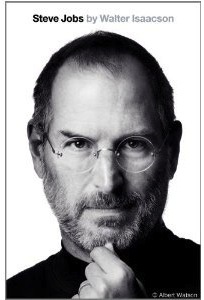
Steve Jobs

Isaacson's biography reveals a disturbing, dark side to Steve Jobs' vision and passion.

Reading all of the accolades heaped on Jobs last October when he succumbed to cancer, you would think that he was a candidate for sainthood. As The New York Times breathlessly reported in its obituary, “Tributes to Mr. Jobs flowed quickly on Wednesday evening, in formal statements and in the flow of social networks, with President Obama, technology industry leaders and legions of Apple fans weighing in.”

Even Jobs’ long-time nemesis, Bill Gates, was quoted as saying, “For those of us lucky enough to get to work with Steve, it’s been an insanely great honor. I will miss Steve immensely.”

Apple itself intoned, “Apple has lost a visionary and creative genius, and the world has lost an amazing human being.”

And yet…

We know from Walter Isaacson’s biography that there was a dark side to Jobs’ incessant quest for perfection.

One of the most disturbing aspects of Jobs’ behavior was the way he treated his family and friends, Apple employees, board members and competitors. Whether it was outright rejection, belittling, conniving, sheer rudeness or even throwing temper tantrums when he didn’t get his way, the picture of Jobs is not a pleasant one.

For someone who exercised so much control and discipline over every aspect of Apple’s brand and products—and make no mistake, that was one of Jobs’ keys to success—it is incredible how undisciplined, uncaring and unfeeling he could be.

Particularly bizarre is the juxtaposition of Jobs’ Zen approach to design, his appreciation of simple, elegant beauty, his penchant for “getting things right,” with the brutal, selfish way he dealt with people. Someone that smart, that committed to perfection, surely had to be aware of how wrong he was in treating others.

So was Steve Jobs’ dark side a blemish on an otherwise great man? Or was it a serious character flaw that compels us to reassess our love affair of all things Apple?

It seems that our society has more tolerance than it should for successful business leaders with flaws. Apple just had its best quarter ever, with a record $13.1 billion in profits. Yes, that’s b as in billion. So if you’re an Apple stockholder, you’re probably thinking, “Bring on the flaws.” But if you’ve ever been the victim of bullying and emotional abuse, you won’t see much to celebrate in Jobs’ life. Rather, you’re left with a feeling of sadness and shame for what could have been.

NYT on iPadJobs’ death at age 56 at the height of his power and creativity seems nearly Faustian. His story certainly raises troubling questions about the responsibilities of leadership—but just as troubling is the enabling of friends, coworkers, employees and consumers.

Writing about Jobs in the Huffington Post last fall, Joel Drucker observed, “The bigger topic is our willingness to turn a blind eye to the Golden Rule in the face of power, charisma and the leverage held by those who sign our paychecks.”

What is the price of admission to work at an “insanely great” company? Did Jobs’ means justify his ends? How complicit are we when we continue to buy Apple products and remain loyal fans?

Anyone who’s watched the film “The Social Network” about Mark Zuckerberg and read Isaacson’s biography of Jobs can’t help but see the dark parallels between these two titans of Silicon Valley. And yet we all spend hours each day on Facebook.

Drucker concludes that he will continue to use Apple products. I have no plans to give up my iMac. In fact, I wrote this post on it. That is the irony and complexity of the Jobs legacy. “Insanely great” is probably as good a summation of Jobs as we’re going to get. While we debate the ethics of Jobs’ behavior, we eagerly await the arrival of the iPad 3.

Posted in Entrepreneurship, Leadership | Tagged , , , | 2 Comments

Emotional intelligence, or confessions of a male model

I’ve spent more time than I care to admit poring over stock photos on websites like bigstock.com, looking for images I can use for my JMC website. You can purchase photos for web use for about $3 a piece, which is far less expensive than hiring a photographer to shoot you talking to clients or looking important behind a desk.

The three truisms of stock photos: The people are young; they are happy; and they can count to 3.

The problem with stock photos, though, is that they’re not “real” people. They’re not you talking to anyone you know. But they are happy people, often smiling and laughing with a golden glow about them, or looking very capable and executive-like. Very upbeat, can-do folks, these stock people are.

So when my friend Michelle Mock, owner of Collaborative Thinking, invited me to be in a photo shoot for her new website, I was happy to accept. It amused me to think that I might be in a “real” stock photo.

I found it surprisingly enjoyable being a male model. I met some neat people and got to listen to a real pro, Michelle, present on the topic of “emotional intelligence.”

Michelle does leadership coaching and asked us to write on Post-it notes the characteristics we most admire about leaders. Many of us wrote down things like “compassionate,” “interested in people” and “good listener.”

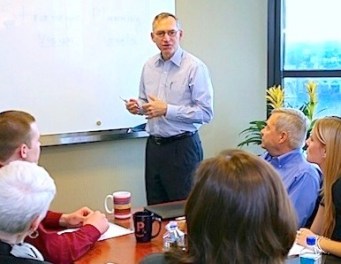
A real guy talking to real people. Photo by Rob Cannon and courtesy of Michelle Mock of Collaborative Thinking.

She then asked us to consider three characteristics—IQ, technical skills and emotional intelligence—and rank their importance in determining a successful leader. As it turns out, emotional intelligence, EQ as it’s called, is by far the most important determinant of leadership.

To drive home her point, Michelle had us all put our Post-it notes on a board that had the three characteristics displayed. As you might expect, the EQ third of the board was covered in yellow stickies. The other two had only a few.

Emotional intelligence is a term that Daniel Goleman popularized in his 1995 book by the same title, and it derives from research done by three psychologists—Howard Gardner (Harvard), Peter Salovey (Yale) and John Mayer (New Hampshire). Essentially, EQ theorists argue that our traditional measuring stick for intelligence—IQ—is too narrow an indicator of success.

Goleman says that successful leadership requires awareness, control and management of one’s own emotions and those of other people. So EQ embraces two aspects of intelligence:

• understanding yourself, your goals, intentions, responses and behavior; and
• understanding others and their feelings.

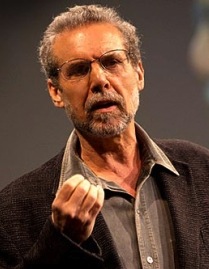
Goleman - photo from forbes.com.

Goleman wrote about the business applications of EQ in a 1998 Harvard Business Review article where he described his research at nearly 200 large, global companies. According to HBR, “Goleman found that while the qualities traditionally associated with leadership—such as intelligence, toughness, determination, and vision—are required for success, they are insufficient.”

Truly effective leaders, he discovered, “are also distinguished by a high degree of emotional intelligence, which includes self-awareness, self-regulation, motivation, empathy and social skill.”

As Goleman relates, “[W]hen I calculated the ratio of technical skills, IQ and emotional intelligence as ingredients of excellent performance, emotional intelligence proved to be twice as important as the others for jobs at all levels.”

When you think about it, what is that je ne sais quoi that you notice most in a good stock photo? Why, it’s the subjects’ emotional intelligence, of course! They’re animated; they’re motivated; and they’re working together on a common goal. In short, they are high on EQ.

So if you need a male model for your next EQ (not GQ) photo, I’m your man!

Posted in Careers, Leadership | Tagged , , , | 2 Comments