This New Year’s, resolve to be less busy and more productive

BusynessIt’s the end of another year, a time for reflection, planning and goal setting. We get out our calendars, dust off our business plans and review our accomplishments over the past 12 months. We congratulate ourselves on achievements, note where we’ve fallen short and adjust our planning accordingly. Then we boldly go forth to conquer the new year—marching forward with renewed purpose and a long list of goals and resolutions.

But before we launch a thousand ships, let’s resolve to make 2016 the year we focus less on busyness and more on business. It’s not about getting a lot of things done. It’s about getting quality things done and getting them done right.

Busyness is a hard habit to break. It bothers us not to be busy. Over the Christmas holidays, I found myself not having much to do. No work projects, no emails, nothing. How could it be so quiet? I fidgeted and thought about things I should be doing. I had a hard time focusing on the present and being still.

Busyness has been aptly described as a “dis-ease,” a disease that can be harmful to our health, our relationships, and our ability to enjoy life and be productive. It seems to have four main causes: First, it’s embedded in our culture. We’re taught at an early age to be busy and to equate busyness with diligence, ambition and success. Lack of busyness, on the other hand, is viewed as a sign of laziness or slacking off. Second, it’s reinforced by our own insecurities. If we’re not busy all the time, something must be wrong with us. We must not have an important enough job or enough get-up-and-go. Third, it’s exacerbated by a lack of planning. If we made a plan and stuck to it, we’d be focusing on the more important things in our life or business. Fourth, we don’t know how to handle downtime. It makes us uncomfortable. We feel we must constantly be doing something.

So each year, we make longer to-do lists and vow to cram more into our schedules. Then we say that we’re too busy to go to lunch, take a walk or visit with our neighbors. We develop metrics that measure things that don’t really matter; we receive emails and attend meetings that waste our time; we labor under processes and procedures that stymie innovation; we continue programs that have outlived their usefulness. We’ve doomed ourselves to perpetual busyness.

We know intuitively that this is the wrong path, that it leads to frustration, burnout and less time with family and friends. But we feel powerless to do anything about it, or we try valiantly for a few months to change, only to fall back to our old ways.

It’s particularly difficult when we work in an environment that rewards busyness—where staying late at the office is a badge of honor and praise is reserved for those who have mastered the art of always “working,” regardless of any real contribution to the organization’s bottom line or mission.

How do we change? Where do we draw the line that says, “No more busyness for the sake of busyness?”

It starts with acknowledging that busyness does not increase productivity. Writing in the Harvard Business Review (“The Remedy for Unproductive Busyness”), Francesca Gino and Bradley Staats note that we have a “bias toward action. When faced with uncertainty or a problem, particularly an ambiguous one, we prefer to do something, even if it’s counterproductive and doing nothing is the best course of action.”

“Choosing to be busy over real progress can be an easy choice; being productive, by contrast, is much more challenging,” the two business professors write. “What helps? Reminding ourselves that taking the time to reflect can help make us more productive.”

They cite a study of 354 Indian manufacturing firms where researchers with the London School of Economics identified two types of CEOs: one group engaged in advance planning while the other was less likely to plan. Surprise: the most successful CEOs were the planners, whose firms had higher productivity and profitability.

Gino and Staats also make an interesting point about soccer goalies, who tend to jump around a lot when defending penalty shots. Statistics show that if they just stood still and planted themselves at the center of the net, they’d block the shot 33.3 percent of the time. When they dive to the left, they only block the shot 14.2 percent of the time. When they dive to the right, they stop the shot just 12.6 percent of the time.

Yet, goalies stay in the center only 6.3 percent of the time. “Why? Because it looks and feels better to have missed the ball by diving (an action) in the wrong direction than to have the ignominy of watching the ball go sailing by and never to have moved,” note Gino and Staats. “By contrast, hanging back, observing and exploring a situation is often the better choice.”

The idea of doing nothing is an anathema to most of us. We truly are ill at ease when we’re idle. Just try putting away your smartphone, disconnecting from social media or skipping an appointment. And yet…

“We need to rediscover what it’s like to do nothing, to sit still, to enjoy silence,” says Leo Babauta in “how to be less busy in a busy busy world.” “We need to put more space in between things, instead of cramming them together all the time. Let’s stop being busy, and start being happy.”

So how, exactly, do we do that?

Below are some ideas Babauta gives, which I think are a pretty good start.

For those who have at least some control over their day:

Make two lists: your ideal day, and all the things that fill up your day (all your commitments). Start by eliminating commitments that are not essential, that don’t make up your ideal day…

Then start following your ideal schedule. Be sure there are spaces between things, so you’re not rushed. Leave large blocks of time wide open, so you can focus on creating or doing what makes you happy. Leave at least one big block for doing non-work stuff, whether that’s spending time with family, or exercising, or doing a hobby, or just relaxing.

Look at your to-do list and see what you can eliminate or delegate or postpone until later. Each day, just choose one or three things to focus on. Have a block of time designated for doing emails and phone calls and smaller tasks, so they don’t interrupt you throughout the day.

Disconnect from the Internet for large chunks of time…Clear away distractions and interruptions so you’re not always switching your attention between things.

Avoid meetings. Seriously. They fill up our days without being productive.

Single-task instead of multi-task. Focus on important things rather than a bunch of little things…

For those who have little control over their day:

See how much of the above you can already implement—you might get further than you think. Mapping out an ideal day, eliminating commitments, simplifying your to-do list, single-tasking, clearing away distractions and interruptions…most people can do most of these things, or if not most things then at least a few.

Tell your boss that you’d like to be more “productive” and that the interruptions and meetings are getting in the way of accomplishing more important things. Tell your boss what you’d like to accomplish, and what you’d like to change about your schedule. Work out a compromise.

Also, think about changing jobs, if you really have no control. This is a longer-term change, obviously, but it’s possible, and maybe even desirable.

In the end, whatever changes you make, you can be less busy simply by changing your mindset, to one where you live in the present rather than always thinking about other things. Slow down, breathe, enjoy every moment. Learn to focus on what’s in front of you, and find peace in whatever you do.

This is the time of year when we make New Year’s resolutions. Perhaps one cure for busyness is to simplify our plans for the new year. Better to set a few achievable goals than to commit to a multitude of unrealistic resolutions that will be abandoned by springtime.

Another antidote is to be intentional about taking time off. Sit down now with your family and plan your vacation for 2016, and then put in for that time in January. That way you really will take a vacation!

As Babauta notes, we can take back our days in small ways. Eliminating distractions, bowing out of meetings, turning off email for parts of the day and building quiet time into our schedule.

Baby steps for some of us who are addicted to busyness, but nonetheless steps in the right direction.

P.S. I’ve written previously about the importance of writing down your plans and reviewing them periodically, setting SMART goals and putting balance in your life. Perhaps some of these will also be helpful to you.

Posted in Goal setting, Happiness, Management | Tagged , , , , , , | Leave a comment

Christmas in the here and now

Bokeh - Candles on dark backgroundChristmas is a magical time of year. Gifts under the tree, choirs singing alleluia, friends and family stopping by, lots of cookies (yum!) and kids giddy with excitement. Even the adjectives are super-sized: merrily on high, most wonderful, joyful and triumphant, royal beauty bright, glory in the highest!
I love the Christmas story. Even if you are not a Christian, you can appreciate the magnitude, the wonder, of a tiny babe born in a manger who is the son of God. Over the years, the story has become both mythic and homogenized, the stuff of children’s pageants, Charlie Brown specials and animated movies. Sure, Mary and Joseph have no money, so they have to camp out in a barn; but the shepherds and wise men still find them, and the angels still proclaim glad tidings.

One of my favorite contemporary Christmas songs is “All is Well” by Michael W. Smith. “All is well, all is well,” he proclaims. “Angels and men rejoice/For tonight darkness fell/Into the dawn of love’s light/Sing A-le/Sing Alleluia.”

Like the little boy in the Christmas classic The Polar Express, you have to believe—believe in something that you can neither prove nor disprove. It’s the beauty, the mystery, the spirit that lifts and transforms us in this season of wonder and awe. So much so, that we can say, “All is well, all is well/Let there be peace on Earth.”

And yet, there is one part of the Christmas story that I don’t like. It’s a part that has always bothered me. It’s like a jagged piece of broken glass that cuts deep into your finger, or a pipe bomb that explodes in a crowded marketplace. You won’t hear it in a Christmas song or see it depicted in a Christmas play, and yet it’s there at the end—a shocking coda that is terrible to comprehend.

It’s in Matthew 2:16, where the writer says, “Then Herod, when he saw that he had been tricked by the wise men, was in a furious rage, and he sent and killed all the male children in Bethlehem and in all that region who were two years old or under, according to the time which he had ascertained from the wise men.”

We don’t know how many baby boys Herod murdered; in fact, we don’t know for sure if it happened since Matthew is the only writer who reports it. We do know from history that Herod was a mad man who killed his own sons and wife. And we know that Matthew’s telling fulfills the prophecy in Jeremiah of wailing and loud lamentation in Ramah—Rachel weeping for her children, refusing to be consoled “because they were no more” (Matt. 2:18).

Contrast Rachel’s uncontrollable weeping and wailing with the peacefulness of the manger where “all is calm, all is bright,” and you have to wonder: what’s going on here? It doesn’t make any sense. It doesn’t conform to our Disneyesque view of Christmas!

That’s because Christ’s birth is not a fairy tale. We tend to forget that he was born into a particular time and place, that he was dropkicked into a mess of hurt and suffering. There was evil and fear then, just as there is now.

When we get to the beginning of John, the fourth Gospel, we learn the significance of Jesus’ birth on a cosmic scale: “In him was life, and the life was the light of men. The light shines in the darkness, and the darkness has not overcome it.” (John 1:4-5)

Our world is nasty, brutish and imperfect, yet the Christ child came into our midst. Was it disruptive? You bet. Did everyone receive the news with joy? No. Perhaps Matthew’s description of the Massacre of the Innocents, as it is sometimes called, is a sign of things to come, a foreshadowing of the other great Christian story of death and resurrection.

By describing the here and now of Bethlehem, and the consequences of Jesus’ coming, Matthew makes Christmas more than just a happy-ending story. The light of God needs substance, a presence to make it flesh and blood and relevant. Matthew gives us that presence, a reality check that forces us to sit up and say, “This is serious. I need to pay attention.”

Christmastime this year is just as real, just as relevant and just as jagged as it was in Jesus’ time. We have our own Herods, our own forms of madness and unspeakable cruelty that must be overcome. Christmas 2015 has as its backdrop mass shootings, terrorism, oppression, racism and poverty. The good news is that the seeds of love that one man planted over 2,000 years ago are still being planted today. His light still shines, and it cannot be extinguished.

So do I believe that it’s “the most wonderful time of the year”? Of course I do, but I also think that we must work hard to keep the spirit of Christmas alive in our hearts and in our actions all year long. It’s a story we must be willing to write anew each day if we truly want its ending to be a happily-ever-after one.

Posted in Purpose | Tagged , , , , , | 2 Comments

What does a Millennial want?

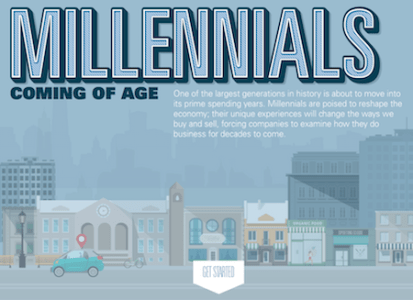
Millennials Coming of Age

Goldman Sachs published research earlier this year on Millennial consumers’ buying habits.

What do Millennials want for Christmas? Or, put more broadly, what do they want, period? It’s a good question, given that my son is an older Millennial, and I’m still deciding what to buy him.

Sigmund Freud famously admitted that after 30 years of research into the feminine psyche, he still couldn’t answer the basic question, “What does a woman want?”

The Millennials have become the most studied and talked about generation since my generation, the Baby Boomers, came along. But are we any closer to knowing what they want?

Well, yes and no.

Earlier this year, Goldman Sachs put together a nifty series of charts, “Millennials: Coming of Age,” that ran as sponsored content on The Washington Post website. The interactive charts were fun to go through and gave lots of information about what we might expect from one of the largest generations in history as it moves into its peak spending years.

Zachary A. Goldfarb of the Post summarized the Goldman Sachs charts in a Wonkblog post, highlighting what Millennials want—and don’t want. Among the things they want:

  • Cheap stuff. Millennials are more price-conscious than previous generations.
  • To be healthy. Millennials put a premium on eating right and overall health.
  • Athletic gear. Millennials tend to spend more on athletic apparel and footwear.
  • Social media. Millennials aren’t just the Facebook generation. They also use social media to make decisions about brands, where to spend time and who to hang out with.

What they don’t want:

  • A house. Fully 30 percent say they never plan to buy a house, another 30 percent don’t feel strongly about it.
  • A television. Only three in 20 Millennials think it’s really important to own a television. They’ve grown accustomed to watching TV on their laptops, tablets or smartphones.
  • A car. Nearly a third of Millennials do not plan to buy a car.
  • A luxury bag. Only 20 percent said it was important or extremely important to have an expensive handbag.

But wait, the Goldman Sachs charts also show that the Millennials’ aspirations aren’t that much different than those of older generations in some key areas. For example, 93 percent of 18-34-year-old renters said they do want to own a home someday. And even though Millennials have been putting off marriage and starting families, 70 percent said they’d like to get married someday and 74 percent want to have children.

Research from Accenture, the multinational management consulting company, challenges some of the enduring myths about Millennials. Accenture looked at the shopping behaviors of 6,000 consumers in eight countries, including 1,707 Millennials. Here are three myths that its research busted:

Myth #1: It’s all about online shopping. “In fact, interviews conducted recently at one of America’s largest shopping malls confirmed our survey findings that many members of the digital generation actually prefer visiting stores to shopping online…When it comes to shopping, we found that 68 percent of all Millennials demand an integrated, seamless experience regardless of the channel.”

Myth #2: Loyalty is lost. “In a recent survey of retail leaders, nearly 40 percent said the No. 1 concern they have about Millennials is their lack of loyalty. But we found that Millennials can be exceptionally loyal customers—provided they feel they’ve been treated right.”

Myth #3: Millennials treat retailers and brands the same as people on social networks. “While clicking an icon on a social network page might indicate that they consider a retailer or brand cool or hip, that doesn’t necessarily mean they are loyal customers…Instead, they view social media relationships with brands and retailers as transactional.”

Another study, “American Millennials: Deciphering the Enigma Generation,” commissioned by Barkley and conducted by Service Management Group and The Boston Consulting Group is also worth a peak.

New paradigms for Millennial engagement in the experience economy from Barkley's research.

New paradigms for Millennial engagement in the experience economy from Barkley’s research.

Among the usual findings (Millennials are “digital natives,” strive for a healthy lifestyle, believe in cause marketing, etc.), Barkley also found that Millennials are in many ways similar to older generations, and they are not a homogeneous cohort. Well, gee, that really helps!

Along that same vein, Adam Smiley Poswolsky, writing in Fast Company (“What Millennial Employees Really Want”), noted that “IBM’s February 2015 millennial study found that millennial career goals don’t differ that much from older generations. Baby boomers, gen-Xers and millennials all want to make a positive impact on their organization and help solve social and environmental challenges.”

Poswolsky, a Millennial himself, says, “My parents’ generation grew up without computers, while my generation can’t remember a life without Facebook. We’re both looking for meaning in the workplace, so how can companies deliver on meaningful employee engagement?”

Among his suggestions: don’t just talk about impact, make an impact; create opportunities for mentorship, skills acquisition and co-leadership; give young talent a voice in your organization; and embrace a workforce that is in flux (“the average millennial is staying at their job less than three years”).

Finally, for a good list of research on Millennials, you might check out Bill Chamberlin’s blog post, “A Primer on Millennials: List of 25 Research Reports.”

Okay, so what to get for my son? I would say that he and I are a lot alike. Neither one of us likes to be pinned down (no long laundry list of gift ideas from us). And both of us will tell you, “I can’t think of anything.” So why not go with a gift card? With a twist: Millennials, it turns out, prefer electronic gift cards. Of course, why didn’t I think of that?

Posted in Communications, Marketing, Technology | Tagged , , , , | Leave a comment

Interest rates, the Fed and taking risks

Asset liability managementThe financial press and the stock markets have been teeing up a Federal Reserve rate hike for weeks. Headline writers and analysts have been in overdrive with a chorus of “Rate increase all but certain,” “Fed poised to raise rates for the first time in nearly a decade” and “Get ready for higher interest rates.”

Will it happen this time? We’ll know tomorrow afternoon when the Federal Open Market Committee makes its announcement. It’s a dicey business trying to predict what the Fed will do. Recall that in the weeks leading up to the FOMC’s September meeting there was a similar hue and cry about a rate increase, and the markets went crazy. It did not happen.

My hat is off to those in financial services who worry about interest rate risk and what it might do to their balance sheets. This summer, I wrote a piece for the September-October issue of The Federal Credit Union magazine on “Asset/Liability Management.” The subhead was “Making sound decisions in uncertain times.” Very appropriate, considering the challenge credit unions face in trying to navigate an uncertain rate environment.

When I wrote the piece, there was talk that rates would go up in the fall. Given the magazine’s lead time, I had to submit my article in July. So I steered away from making any hard-and-fast statements about rate increases. That turned out to be prescient because the FOMC decided to leave rates alone and kick the can down the road.

A quote from economist Edward de Bono for the article neatly summarized the task at hand: “If you cannot accurately predict the future, then you must flexibly be prepared to deal with various possible futures.” That, in a nutshell, is the job of asset/liability committees and credit union risk managers.

The chief financial officers I interviewed were unanimous in stating that it would be foolish to try to predict what the Fed will do. Besides, interest rate risk is only one of many risks that can erode your capital. Just as serious, perhaps even more so, is liquidity risk, not to mention credit risk.

As any successful business leader will tell you, there will always be risk. If you’re too afraid of it, you’ll end up making shortsighted decisions that limit your opportunities. Healthy organizations recognize that some level of risk is acceptable in order to accomplish goals and grow.

Entrepreneur and amateur race-car driver Tom Panaggio makes these two points about risk and leadership on Skip Prichard’s Leadership Insights blog that are worth remembering:

There are two big advantages to risk.

First and foremost, risk is directly connected to opportunity. Every opportunity must have an element of risk or there will be no benefit. Risk is the cost of opportunity. All businesses and organizations must be in a constant state of forward progress because of competition and the ever-changing demands of customers… A leader who recognizes the vast importance of forward motion for their organization accepts risk as merely a cost of opportunity and then actively endorses this philosophy throughout his business in setting the stage for long-term success.

Secondly, because most people have a tendency to avoid or minimize risk, those who have the courage to embrace it already have a competitive advantage. For example, my company was a nonstop marketer. We knew that our competition was not willing to risk the investment in marketing to the degree that we were. So we took advantage of their unwillingness to risk the marketing dollars and dominated our market space by out-marketing them. We put ourselves in a position to win by embracing the risk of marketing.

I personally am ready for the Fed to bite the bullet and get this interest rate hike over. Never has there been so much angst over 25 or 30 basis points, or whatever it will be in the end. Let’s just do it and get going with that Santa Claus rally!

Posted in Entrepreneurship, Management | Tagged , , , , , , | Leave a comment

Thanksgiving, gratitude and the value of encouragement

Thank YouThe other day an email popped into my inbox from HostGator, my web-hosting company. I get marketing emails from them from time to time, so I didn’t pay much attention at first. But the headline caught my eye: “Want instant business karma? Try philanthropy.” As it turns out, the entire email was devoted to gratitude. Of course, this is the season, and tomorrow is Thanksgiving after all. Most of the marketing we see this time of year, though, is screaming Black Friday deals and free shipping. It’s a mixture of sales hype and holiday cheer designed to make us feel good about emptying our wallets and pocketbooks.
But the HostGator email made me pause. So did REI’s well-publicized decision to close its stores on Friday and give all of its employees the day off. Maybe, just maybe, this gratitude thing is catching on. In the HostGator email there was a survey asking, “What’s the best way to show customers gratitude during the holidays?” Respondents were given three choices: Donate to a charity chosen by your clients, host a community holiday party, or send personalized cards or notes of thanks. Which one do you think got the most votes (including mine)? Sending personalized notes of thanks was by far the most popular choice (66 percent). The other two garnered about 18 percent each.

I have written before about the power of handwritten notes, showing gratitude and giving. Below, I’ve excerpted a few nuggets of wisdom from a past blog for your reading pleasure this Thanksgiving.

But before I cut and paste, let me leave you with a few points about giving thanks that I was reminded of recently:

  1. Giving thanks does not require a special occasion or holiday. Learn to give thanks every day—for the many blessings you receive and the small acts of kindness you might otherwise take for granted.
  2. Giving thanks does not happen by itself. Gratitude needs to be cultivated and practiced. Be intentional about giving thanks, especially in those moments when you don’t feel particularly grateful.
  3. Giving thanks is not a silent activity. Unless you tell people thanks, acknowledge their work or express your appreciation, how will they know?

Happy Thanksgiving!

From “Giving and the high performance leader” (Dec. 6, 2012)

In his book “Design a Life that Works,” Michael Alan Tate suggests that giving is a key characteristic of high-performing leaders. He tells of a business leader he was coaching who had incredible technical knowledge, plenty of experience and lots of drive, but he lacked the spirit of generosity. As a result, this leader wasn’t able to motivate his team and achieve the results he wanted.

Tate argues that successful leaders subscribe to four “give factors”:

Give thanks…for what you are most grateful for at this time.

Give credit…to those most responsible for your success, helping you and being there for you.

Give back…with greater frequency in a selfless way.

Give up…or let go of something intentionally to reach a new level of success.

*   *   *   *   *   *   *   *   *   *   *   *   *   *   *   *   *   *   *

When I think back on the CEOs I’ve worked for in my career, it’s the giving ones that stand out. The ones that encouraged staff through their words and deeds, demonstrated compassion and trust, and honored each employee’s dreams and aspirations.

What does generosity look like in a leader? Here are nine giving “to-do’s” from an article by Bruna Martinuzzi on the Mind Tools website. See how many of these you do.

  1. Give people a sense of importance.
  2. Give feedback, not criticism.
  3. Give people visibility.
  4. Give anonymously.
  5. Know when to forgive.
  6. Give encouragement.
  7. Give opportunity.
  8. Share your knowledge and experience.
  9. Give moral support.
Posted in Leadership, Purpose | Tagged , , , , , | 2 Comments

Right brain, left brain—let’s just call the whole thing off

chemistry

By the time I finished high school, I was pretty certain that I would not be majoring in engineering when I went to college. I say that because my dad is an engineer, and that’s what my brothers and my son all majored in. Mechanical, electrical, chemical and civil—my family seems to have it covered. I am the lone basket-weaver, as my brother Craig used to say.

While my brothers excelled in math and the hard sciences, I struggled with algebra 2/trig and physics (although I liked chemistry). So I decided to pursue a liberal arts education. When I was at UVA, I gave math one last try when I signed up for accounting and economics. I thought I might transfer into the Commerce School and become business major. I had visions of being courted by the big accounting firms.

Alas, it was not meant to be. I majored in English, and so no recruiter ever called, much less took me to dinner or flew me, expense-paid, to some glittering corporate headquarters. Like most of my friends, I dutifully sent out resumes and worried that four years of college had been wasted in pursuit of something totally impractical (like basket weaving). What separated me from some of my fellow English majors is that I had written for the Cavalier Daily, UVA’s student newspaper. I left school with a folder full of clips that I could show prospective employers.

engineering humorAnd so began my career as a writer, editor and public relations professional. I do not regret it. I have learned over the years that right-brain thinking has its advantages. After all, right-brain thinkers are the ones who rule world, right? Only two U.S. presidents have been engineers—Herbert Hoover and Jimmy Carter. Need I say more? Hoover presided over the Great Depression and Carter over high interest rates and the Iranian hostage crisis. Interestingly, both had more successful careers as elder statesmen after they left the White House.


Dividing our thinking into right- and left-brain categories has some advantages. It helps us to understand different ways of viewing the world, processing information, solving problems and communicating.

You might remember the book, “Drawing on the Right Side of the Brain,” by Betty Edwards. It was a landmark book when it was published in 1979. I remember using it in a drawing class I took in the 1980s at Northern Virginia Community College.

Edwards’ thesis was that our brains have two ways of perceiving and processing reality—verbal and analytical versus visual and perceptual. Edwards created a methodology and exercises for suppressing the left side of the brain and heightening the right side.

So in class, we were taught to disregard preconceived notions of what drawn objects should look like. I remember copying images upside down, drawing with our eyes closed, doing quick sketches without regard to whether the subject looked true to life and all manner of exercises designed to break us of the habit of drawing analytically. And you know, it actually worked!

Edwards was influenced by neuroscience research that seemed to indicate that the two hemispheres of the brain have different functions. She described “L-mode” thinking as verbal, analytical and sequential and “R-mode” as visual, perceptual and global.

Drawing on the right side of the brain

Edwards’ book changed the way drawing is taught and got a lot of people thinking about right brain vs. left brain.

In the intervening years, this right-brain/left-brain approach to thinking spawned a new movement in management that emphasizes soft skills, emotional intelligence and creativity.

In his 2006 book, “A Whole New Mind,” Daniel Pink argues that right-brainers are now on the ascendancy. We once needed an army of programmers, engineers and lawyers, he says, but today we need more artists, inventors and designers. Pink says that moving from the Information Age to the Conceptual Age will require new skills, among them: design, storytelling, invention, empathy, big-picture thinking, play and the pursuit of meaning.

The aptitudes that Pink identifies as being important in this new Conceptual Age are the very ones we’re now seeing Millennials value in their work and favor in the marketplace. But in our haste to embrace these new, softer skills, we shouldn’t lose sight of the left-brain virtues of logic and reasoning, nor the fact that a full complement of skills is needed manage an organization.

More recent research on how the brain functions no longer supports the notion that one hemisphere of the brain is more logical or creative. In fact, both sides of the brain contribute to both types of processes. The two sides of the brain collaborate to perform a variety of tasks, communicating through the corpus callosum that joins the two hemispheres together.

In a piece for Discover magazine, science writer Carl Zimmer summarized this more nuanced, integrated approach to brain activity, explaining, “The pop psychology notion of a left brain and a right brain doesn’t capture their intimate working relationship. The left hemisphere specializes in picking out the sounds that form words and working out the syntax of the phrase, for example, but it does not have a monopoly on language processing. The right hemisphere is more sensitive to the emotional features of language, tuning-in to the slow rhythms of speech that carry intonation and stress.”

Rather than conjecturing that one way of thinking is more dominant, depending on whether we’re right-brained or left-brained, it’s more helpful to think of both sides of our brain working together in a collaborative fashion. It’s like an orchestra playing a symphony that requires both a high degree of lyrical sensibility and perfect execution. All of the parts of the symphony and all of the instruments in the orchestra combine to create a memorable performance.

While I often think of myself as a “creative,” I’ve always had a very practical and logical side. I’m pretty good with budgeting and finances. I have a scientific mind in that I’m naturally curious and skeptical. I like hard proof before I make a decision. I like technology. I like to tinker, and I love the challenge of finding out how something works, whether it’s a machine or a computer program.

So maybe it’s time to stop categorizing people as right-brained or left-brained. Perhaps we should be more concerned with developing the talent that we have and recognizing the unique strengths and contributions that each of us brings to the table. At the same time, we must understand that the best organizations are those that cross-train and encourage their team members to innovate, take risks and grow into new roles. Let us strive to bridge right-brain and left-brain thinking, honing both hard and soft skills to effectively plan, analyze, motivate, inspire and lead.

Posted in Careers, Management | Tagged , , , , , , , | Leave a comment

‘Break every chain, break every chain, break every chain’

Razor wire

I never get used to the razor wire and clanging of metal doors when I visit Greensville, yet that is where I find peace with my Kairos brothers.

You could hear a pin drop at our table at Greensville Correctional Center in Jarratt, Va. It was chapel time. Six residents and three volunteers sitting in a circle in a prison gym, leaning in to hear one of our Kairos brothers unburden his heart.

“For a long time, I had a lot of anger…a lot of hate,” the man began. The words came out slowly, punctuating the silence, pulling us closer as he related his story.

“You see that prayer chain,” he said as he pointed to a paper chain taped to the wall. The chain had hundreds of links, each one inscribed with the name of a person praying for the 42 residents who were part of Kairos 57.

“There are different colors on that chain, and I could’ve been one of the white ones,” he said softly. The white strips on the prayer chain held the names of death-row inmates.

His story tumbled out and his eyes moistened. It was a story like many I’ve heard in my four years as a member of the Northern Virginia Kairos prison ministry team. We tell the residents that what’s said at Kairos stays at Kairos, so we don’t share the details of what we hear.

Except to say that it comes down to this: 10, 15, 20 or more years behind bars. Years of anger, doubt, fear, shame and every dark emotion you can imagine—all bottled up inside. And then, for many, freedom. You would think the prospect of release brings joy. Yet, they are afraid. Afraid of what they have become in prison, and afraid of what they will face when they go home. They don’t know if they can trust. They never could before. And yet they want to. They want to believe that there is a better way, a way to make peace with themselves, their families and each other.

All weekend long, we shower them with our love and our prayers, our conviction that there is a higher power, a forgiving God who cares about them. We can’t change the nature of their crime or their sentence, but maybe, just maybe, we can change the condition of their spirit. Perhaps the seeds of trust and healing we’ve planted will grow, even in prison.

I’m not a counselor or a chaplain. I had never even been in a prison, much less Virginia’s largest penitentiary, prior to signing up for Kairos. But it doesn’t take a PhD in psychology to figure out what these men are going through and what they need. We all have our doubts and misgivings, demons that tempt us, people we can’t seem to forgive, memories we can’t forget—the “what ifs” and “could haves” that haunt everyone’s life. We do not judge these men. By the same token, we do not coddle them. In fact, we teach them that we all make choices, and that we must accept the consequences of our choices. But we do share with them. We’re honest about our mistakes and our hopes and our dreams. We make ourselves vulnerable so that they might open up for a brief moment, long enough to let in some love that may just change their lives. We face the human condition straight on, and we come away understanding that we are all brothers. We all hurt. We all need comforting. We all need forgiveness—whether we live inside or outside the walls of Greensville.

It’s been a year since I wrote about my last Kairos experience. It’s not an easy thing to write about. One of my friends who became active in Kairos before me said after he returned from his first weekend that he wasn’t ready to talk about it. He would get back to me, but he never did.

When you enter a dark place and see the work of a loving God—the miracle of grace and forgiveness—what do you say? What do you say when you’re touched by Jesus, the holy spirit, or something you just can’t explain? When you see it at work, when you feel it, and you know it’s real? When you see the difference it makes? What do you say to someone on the outside to make them believe?

You say that Kairos is a powerful experience, that it changes lives and that it’s a special time. Those are all true, but they only tell part of the story. It’s hard to put into words what really transpires. Sometimes you just have to let it be.

This past weekend, the Kairos praise band performed one of my favorite gospel songs, “Break Every Chain.” As I stood and sang, I closed my eyes and said a prayer: Yes, break every chain. Break the chain of doubt and fear. Break the chain of ignorance and hatred. Break the chain of violence and abuse. Break the chain of darkness and death. Break all those chains, and replace them with a chain made of paper—a prayer chain stretched across a wall at Greensville Correctional Center—with the names of people who say, yes, God, I will pray for men I don’t even know so that they may live.

Posted in Purpose | Tagged , , , , | Leave a comment

Need to make an apology? Here’s how to do it right

I'm sorry“I’m sorry” and “excuse me” are words we hear on a daily basis. When used liberally and expressed sincerely, they go a long way towards preserving civility and smoothing over awkward moments. If I accidentally bumped into you on a crowded Metro train, of course I’d say, “Excuse me.” And you would nod, knowing that I didn’t mean anything by it. Just the jostling of the trains.

In these social situations, saying we’re sorry doesn’t take an awful lot of effort. It’s a habit as much as anything, part of being polite and having good manners. But if our actions descend to the level of boorish, unfeeling, callous or incompetent, then we’ve veered into new territory. We may need to issue an apology. This is especially the case if we represent a company or an organization whose reputation we are entrusted to protect.

Unless you’re Donald Trump and don’t have to apologize for anything, there will be times when you need to own up to your lack of judgment or your company’s poor performance. And while The Donald doesn’t do apologies, I’ll bet the managers of his hotels do if a customer isn’t treated right.

There are many guides for writing apologies, and you can find tons of examples on the Internet. Over at apologyletters.net, there are sample apology notes for every conceivable shortcoming. No matter what you’ve done wrong, they have a letter for it!

However, I would strongly urge against using fill-in-the-blank templates. Like thank-you notes, apology letters are most effective when they are heartfelt and personal. It’s best to write your apologies in your own words. Business and professional apologies can be more formal, but they should still be personalized and certainly tailored to the specifics of the situation.

So what, exactly, should be in your apology letter? Listed below are the essential elements of a good apology. Follow these five steps, and you’ll be well on your way to mending fences:

  1. Acknowledge the problem, but from the recipient’s point of view, not your own. Put yourself in the shoes of those you have let down or offended. Make it clear to them that you appreciate their concerns, that you understand why your behavior was disappointing, hurtful or uncaring. In short, name the offense and own up to it. Do not gloss over it or resort to being glib.
  2. Say that you are sorry in plain, simple language. Do not make your apology conditional. Do not embellish or make excuses. Demonstrate that you genuinely regret what has happened.
  3. Provide an explanation, particularly if there are extenuating circumstances, but only to help clear up the situation. Again, do not excuse your behavior or try to assign blame to anyone else, especially the person you are apologizing to. Describe what you will do to correct the problem so that it will not happen again.
  4. If appropriate, offer to make amends. This could include reimbursing someone for expenses, offering a replacement or similar product or service, providing a credit or giving a discount on a future purchase.
  5. Conclude by asking the person to accept your apology. If appropriate, thank the recipient for bringing the matter to your attention and providing honest feedback so that you can continue to improve.

Also, keep in mind these other key points in writing or giving an apology:

  • Stick to the subject of the apology. Do not cover other topics.
  • Do not delay in apologizing, especially if delaying may cause further injury to your relationship or to your reputation.
  • Avoid the non-apology apology. Politicians and other public figures often resort to saying they are sorry in self-serving and insincere ways. (“I’m sorry my office did not release the facts right away, but I personally have done nothing wrong.”) Such apologies are not really apologies at all.
  • Saying you are sorry doesn’t necessarily mean that you are liable. However, use your judgment when issuing an apology. Obviously, you should avoid saying things like “this never would have happened if we were doing our job” or “we were clearly negligent.” Consult with an attorney if you are concerned about liability issues. Some states have laws that prevent defendants from using an apology as evidence of liability (for example, in a malpractice lawsuit).

In this summer of candidate non-apologies, we haven’t seen the best examples of how a sincere apology can mend a broken relationship, restore feelings of worth and dignity, or repair a damaged reputation. Writing in Psychology Today 10 years ago (“Go Ahead, Say You’re Sorry”), Aaron Lazare made these points about apologizing that may be even more appropriate today:

Far and away the biggest stumbling block to apologizing is our belief that apologizing is a sign of weakness and an admission of guilt. We have the misguided notion we are better off ignoring or denying our offenses and hope that no one notices.

In fact, the apology is a show of strength. It is an act of honesty because we admit we did wrong; an act of generosity, because it restores the self-concept of those we offended. It offers hope for a renewed relationship and, who knows, possibly even a strengthened one. The apology is an act of commitment because it consigns us to working at the relationship and at our self-development. Finally, the apology is an act of courage because it subjects us to the emotional distress of shame and the risk of humiliation, rejection and retaliation at the hands of the person we offended.

All dimensions of the apology require strength of character, including the conviction that, while we expose vulnerable parts of ourselves, we are still good people.

Posted in Communications, Leadership | Tagged , , , , , | Leave a comment

Everything I know about management I learned from gardening

Garden

Things are looking pretty good in my garden, where I’ve learned many lessons about management.

It’s September again. The days are getting shorter, the nights cooler. The grass is staging a comeback, the liriope is in full bloom and the crepe myrtle is taking its final bow. As I walk around the yard, taking stock of this year’s horticultural successes and failures, it occurs to me that everything you need to know about management—about life, really—can be found in the garden.

If you think about it, many of the skills of a master gardener are transferable to the C-suite. Just as good leaders understand their people, gardeners know their plants. They know when to nurture and prune to promote growth—and when to remove and discard and start anew. They measure progress by seasons and years, not by days or weeks. They enjoy the fruits of their labor and learn from their mistakes. They take risks, but they also carefully plan for the future. They know that nature, like the marketplace, can be harsh and fickle but also wonderfully generous.

I’ve always liked working in the yard. It began when I owned my first house and then became an obsession when I moved to an older house with a bigger yard. It was there that I got a little crazy, ripping out everything and starting over with all new landscaping. I learned a lot about plants, about preparing the soil, about fertilizer and pesticides. I watered. I made numerous trips to nurseries, read lots of books. And I watered. Always watering.

I experienced great satisfaction, and I had my share of setbacks. Two small yews I planted on the front and side of the house slowly grew into perfect specimens. They would have made beautiful Christmas trees. On the other hand, English ivy I foolishly planted on one side of the house became unmanageable almost immediately.

Camellia

My camellia in bloom.

I learned that gardening favors those who persevere. It teaches patience, that things happen in due course, and you must wait for the good things. Take the camellia in my backyard. It almost died shortly after I planted it. I came home from work one day and found it toppled over, its root ball exposed. I put it back in the ground and watered it. Then I staked it on all four sides to keep it from falling over. I brooded over it all summer and into the following year. It survived and started to take off a few years later, and now my garden is the better for it.

When I was in management, I enjoyed mentoring employees and building teams. Like the farmer who surveys the progress of his fields, I have watched young saplings grow into tall trees. What if I had given up on the employee who didn’t quite fit in, the one who took longer to get the job done in the beginning, or the one who needed a little nudge or just some time to come into his own? Would those employees have matured into mighty oaks or withered from lack of support?

The best managers are those who understand they are stewards, entrusted with the care and feeding of their organization. That’s not to say that we should coddle employees or turn a blind eye to unsatisfactory performance. Like plants, some employees do not do well, no matter how much Miracle-Gro we give them. Sometimes we have to transplant them or remove them entirely.

So the next time you’re in the yard or admiring your neighbor’s prize roses, consider these seven management lessons from the garden:

  1. Take the long view. Remember, good things come to those who wait. It takes patience, perseverance and faith to grow something big from something small.
  2. Know your people. Understand how they perform in different climates and different seasons. Then place them in an environment where they will thrive.
  3. Give your team the resources to succeed. Make sure your organization has the water, nutrients and sunlight it needs to grow.
  4. Have a vision. Maybe there’s nothing but weeds or dirt in your backyard. Think about what it could be, then go to work on making it happen.
  5. Not everything that grows is desirable. Learn to identify and quickly remove weeds, pests and disease. There is no room in your organization for dishonesty, prejudice, selfishness, laziness or complacency.
  6. We all labor under the same sun. Everyone has the same growing season, the same 24 hours to get things done. So plan and execute accordingly.
  7. You cannot control everything. Sometimes death and destruction visit the garden despite all of your hard work. When they do, salvage what you can and move on.
Posted in Leadership, Management | Tagged , , , , , | Leave a comment