Story time isn’t just for bedtime

“Hey, kids, who wants to hear a story?”

As a child, those words were music to my ears and still are today. After all, who doesn’t like to hear a good story?

Storytelling is the way we communicate on the most personal level. It is, without a doubt, one of the most powerful ways to convey a message. From bedtime tales when we are toddlers to water cooler talk when we are grownups, we love and respond to a well-told story.

Last week, I wrote about the importance of storytelling in public relations on the PRSA-NCC Blog. As I thought more about this topic, it occurred to me that I had recently put the power of storytelling to a real-life test.

Let me explain.

This fall, my friend and former NAFCU colleague Peter Taylor lent me two books to read: a self-help book describing the steps to creating a one-page life plan and a novel that, coincidentally, also dispensed some helpful career advice.
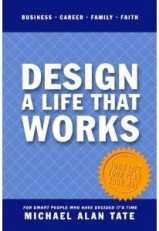
Design a Life That WorksI immediately tackled the self-help book because it seemed to be exactly what I needed to finally get going on a business plan. But Peter also did something ingenious that caused me to read it right away. He checked it out of the public library; and when he gave it to me, the clock was already ticking. With just two weeks until the due date, Michael Alan Tate’s “Design a Life that Works” definitely moved up on my reading list. The fear of an overdue library book is one of those childhood anxieties that never quite leaves you. It certainly had its intended effect because I finished the book in no time!

Under an Orange SunIrving Belateche’s “Under an Orange Sun, Some Days are Blue” didn’t come from the library, and so it sat on my desk for a good long while before I read it. With no deadline, there didn’t seem to be any rush to start it. I’m not sure what finally prompted me to pick it up; but when I did, I could barely put it down. The taut writing (Belateche is a screenwriter) and first-person narrative hooked me from the beginning. But what really got me was the poignant story of Belateche’s loss of his six-year-old daughter to leukemia, the resultant depression that he fell into, the impact it had on his writing and then, finally, how he pulled himself out of his “deadworld,” as he calls it.

So which book do you think moved me the most? You guessed it, the story by Belateche. Writing on The Huffington Post blog last year, Belateche noted that “the most powerful motivational books are those where someone takes you through their own personal journey.” Exactly!

So what about Tate’s book? It’s good, too, in it’s own way. But it follows that familiar formula you see in so many of these types of books: motivational quotes from famous people, anecdotes from the author, some basic action steps, some exercises and some examples of how others have done it. To his credit, Tate has a template you can follow to write a one-page life plan. In fact, you can get it off of his Resources page if you know the password. (Psst, it’s “yourway.”)

Perhaps it’s just my lack of enthusiasm for planning, but the book didn’t prompt me to do what I had hoped it might. I didn’t sit right down and hammer out a business plan. Writing a plan is one step higher on my to-do list, but, still, there it sits. Sigh.

In a future post, I’ll tease out some of the salient points from Tate’s book as I begin to write my plan. In the meantime, take a look at this troubling article (“Common core sparks war over words“) from Sunday’s Washington Post about how the study of literature is being eliminated from public school curricula. It’s the result of a new and confusing “common core” standard that is causing English teachers to favoring nonfiction “informational texts” over fiction. Yikes, it looks like story time may be fading away; and that’s a tragedy, if you ask me.

Posted in Careers, Goal setting | Tagged , , , , , | 2 Comments

Powerball, homelessness and having enough

I’ve been thinking a lot lately about “how much is enough,” mostly in the context of my little PR and marketing firm. As I complete my first year of business and reflect on lessons learned from this experiment I call JMC, my thoughts inevitably turn towards measuring its success, and that in turn leads to dollars and cents.

I set relatively low (and I thought attainable) revenue goals for JMC in its first year of existence. After all, I thought, “You’re just getting started, you have no clients and it’s a down economy. So, for Pete’s sake, go easy on yourself.” As it turns out, I will probably fall short of those goals, although that shortfall in itself is a lesson in timing and some unrealistic expectations.

What would you do if you suddenly won $588 million?

What would you do if you suddenly won $588 million?

This question of “how much is enough,” especially in the hyper-affluent Fairfax County where I live, took on a new twist last night. These last few years, I have volunteered to spend the night with our homeless population as part of my church’s  hypothermia program. Each time I do it, I go home with new insights and newfound respect for a group of people I didn’t think I had much in common with.

Last year, I went home and wrote “Black Friday, business plans and the homeless.” This year, the topic of “how much is enough” weighed on me again as I drove home—but in a new light. On these long nights, we often have homeless guests who want to stay up. They can’t sleep on the hard floor, they have insomnia, they need company—whatever the reason, they become welcome conversation partners.

Last night, one of our guests steered the topic to the record $588 million Powerball jackpot and what he would do if he won all of that money. This led to a lot of joking about sudden wealth, but then the conversation turned serious when he asked about five of us sitting together what we would do.

Most of us answered that we would pay off fairly modest debts like a mortgage and take care of family members, but no one talked of wildly extravagant spending. In fact, most talked about the good they could do for others with all of the money. Then we asked what he would do. This was a young man, and I half expected an answer that involved the purchase of an expensive car or travel to exotic places—in short, all the trappings of a jet-set life.

So imagine my surprise when he shared his desire to start an organization that would help the homeless out of poverty. He talked about establishing a place where the homeless could stay temporarily, get job skills and find work, learn self-reliance and how to make better life choices. It was obvious our friend had done some heavy thinking.

When I think about my own life, I realize that I have always enjoyed what you might call an abundance of sufficiency. In other words, I have always had enough. There were certainly times in my life when I thought I wasn’t paid enough, didn’t have all the material possessions that I wanted or hadn’t earned the success I coveted, but those were the “extras.” I’ve never gone without the “basics”—food, clothing, shelter, healthcare, transportation. I’ve always found the money to pay for those things that really mattered to me or my family. I may have sweated tuition payments, house payments and car payments—but somehow they always got paid.

So what is enough? And how do we know when we’ve attained it? And, more importantly, when do we stop chasing those things we really don’t need or can’t afford?

Perhaps we know it when we hear a homeless man talk about the good he would do for others with $588 million.

While at times this past year, in my belt-tightening to make up for lost income, I’ve felt I’m the Prince of Austerity, deep down inside I know that I will be provided for, one way or another. I have what I need, and that’s enough.

Posted in Happiness, Purpose | Tagged , , , , | 6 Comments

Content marketing, storytelling and blogging

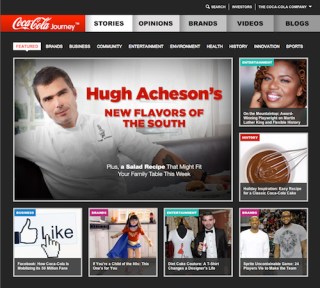
Coca-Cola’s new content-rich website.

“Content marketing” is all the talk these days among marketers and advertisers. But the more I hear and read about its use by big-name consumer companies like Coca-Cola and P&G, the more I have to wonder, “Where have these guys been? This is exactly what good communicators have been doing for years!”

Consumers don’t want to be interrupted or over-sold, according to content marketers. They want to connect and be engaged. They want information; they want to be touched in more personal and intelligent ways. Well, of course!

Consider this definition of content marketing from the Content Marketing Institute:

Basically, content marketing is the art of communicating with your customers and prospects without selling. It is non-interruption marketing. Instead of pitching your products or services, you are delivering information that makes your buyer more intelligent. The essence of this content strategy is the belief that if we, as businesses, deliver consistent, ongoing valuable information to buyers, they ultimately reward us with their business and loyalty.

You won’t get any arguments from me on that one. To this long-time PR professional and business communicator, content marketing has a very familiar ring. It appears that certain marketers have finally discovered the value of telling a story vs. pitching a product. It’s about time!

In writing about Coca-Cola’s new content-oriented website, launched last week, The New York Times noted that the site’s “changes are indicative of the growing interest among marketers in recasting their communications with consumers as storytelling rather than advertising. Just as attention is being paid to developing content to use for brand storytelling, an appetite also exists for corporate storytelling.”

Much has been written about so-called business storytelling and how, particularly with social media, it is imperative for companies to use stories to create a connection between their brand and their customers and fans. It appears that Coca-Cola has made a conscious effort to do just that with this new site that looks more like a digital magazine than a corporate website.

If you haven’t looked at it, I recommend you take a peak. It’s really quite extraordinary.

What I take from all of this is that there is extreme value in what I and my fellow communicators do for a living. It also makes me feel good about keeping up my blog and connecting with readers.

And for my fellow bloggers out there, you should keep it up, too! You’ll note on the Coca-Cola site there are multiple blogs, in addition to a well-executed opinion section. Blogging is alive, and there seems to be renewed interest everywhere in good content.

Posted in Marketing | Tagged , , , , | 2 Comments

Letting go and moving on

Last month, I wrote about the power of forgiveness and how learning to forgive yourself (as well as others) is essential for personal growth and change. All too often, we hold on to old hurts, grudges and mistakes, and they become obstacles to enjoying life, advancing in our careers or successfully running a business.

Forgiving is the first step, and that is hard enough. But an equally difficult and necessary second step is letting go of past wrongs and then leaving them behind—forever.

New Thought leader and author Emmet Fox put it this way in his advice to leave old grievances buried:

Don’t be a grave robber. Let corpses alone…Every time you dig up an old grievance or an old mistake by rehearsing it in your mind or, still worse, by telling someone else about it, you are simply ripping open a grave—and you know what you may expect to find.

Live the present. Prepare intelligently for the future—and let the past alone…Life is too precious for grave robbing. The past is past—liquidate it. If a negative memory comes into your mind, cremate it with the right thought (the fire of Love) and forget it. (From “Around the Year with Emmet Fox.”)

John Baldoni had a great post on the HBR Blog a few years ago called “To Lead, Let Go of the Past.” Baldoni offers these three questions to help managers who may be stuck on the past:

What do you want to accomplish? Managers are trained to plan in order to achieve organizational goals. That same skill can be applied to overcoming a past mistake. Acknowledge it. Treat it as if it were a goal that you would like to achieve. Doing so will enable you to distance yourself from it personally and treat it only as a management issue.

How will you accomplish it? Prioritizing resources to achieve the goal is essential in management. Know what you need in terms of material, people and time lines. That same skill can be applied to letting go of something. Treat the failure to let go as a roadblock that you must surmount. Take it apart bit by bit, or blow it up all at once.

How is holding on to the past going to help you achieve your better future? Good managers are nothing if not pragmatic. If something isn’t working, you try something new. Ask yourself how you will let go. Do you need to talk to a colleague, a coach or a trusted friend? Just as you need help in accomplishing a management objective, you may need help in letting go of the past.

Baldoni concludes by saying: “Most senior managers know what it feels like to make a mistake for which you are accountable. True leaders don’t get stuck on it. They correct the mistakes and move on. The ones who don’t end up living lives of ‘quiet desperation,’ never able to let go of what has already come and gone.”

This past weekend, I gave a series of meditations on the importance of forgiveness at a Kairos prison ministry retreat. In giving the talks, I realized the words were meant for me as much as the 42 inmates who attended. Regardless of our situation in life, we all need forgiveness. And we all must learn to accept our mistakes and move on.

Image from justbesplendid.tumblr.com.
Posted in Leadership, Management | Tagged , , , , | 2 Comments

Exercise, health and having a purpose

Exercise is one of those things that you either love or hate. All my life, I have firmly been in the “hate” camp. Forcing myself to exercise just seems to be the low point of my day. I try to put it off, or I convince myself there are just too many meetings or projects for me to do my full workout.

Photo from pro-active.co.uk.

But as I get older, health has moved up on my priority list. You put on some years (and a few pounds), and all of a sudden you’re like a car owner sweating over the fine print in an extended warranty. Will all of my parts actually last as long as they’re supposed to?

Of course, no self-help book would be complete without a chapter on the need for exercise. It’s one of the keys to leading a balanced, productive life. Seems like everyone should be on-board with that, so why is it so hard for otherwise smart, highly motivated people to exercise?

Maybe our reasons for exercising aren’t aligned with our goals. I am trying to wean myself from a life-long attitude that exercise is drudgery to it being something I actually want to do. Yikes, is that possible?

If you consider the bigger picture, I think it is. I recently picked up a little book by John Maxwell called “Make Today Count: The Secret of Your Success is Determined by Your Daily Agenda.” Maxwell’s guide to setting priorities includes chapters on attitude, family, finances, relationships, values, growth—and, yes, health.

The health chapter starts with the story of Maxwell’s poor exercise and diet habits and a life-changing heart attack. So, surprise, surprise, he now exercises and eats sensibly, I thought. Well, that’s true. But I was pleased to see a few other items listed under “health” that I didn’t expect:

Have a purpose worth living for.” Bingo. As Maxwell puts it, “When you have something to live for, not only does it make you  desire a long life, but it also helps you to see the importance of the steps along the way.” When I think about all of the things I want to do in my life, I begin to see that good health is necessary for me to accomplish them. And then I’m much more willing to climb onto my NordicTrack…for awhile.

“Do work you enjoy.” This may not always be possible, but I agree with Maxwell on two points: 1) Work that isn’t fulfilling or enjoyable can lead to frustration, stress and burnout. 2) Work that constantly puts you in a zone of weakness can also be harmful. Here’s a good indicator: “One of the ways you can tell you’re working in an area of strength is that it actually gives you energy.”

“Find your pace.” According to Maxwell, “Part of taking care of yourself includes finding and maintaining the pace that’s right for you. If you take life more slowly than your energy level is capable of, you can become lazy. If you continually run at a pace faster than you are capable of, you can burn out. You need to find your balance.”

“Accept your personal worth.” Learn to accept yourself and have confidence in your abilities, even if others don’t. This is especially true if you’re starting your own business or changing careers. You definitely have to believe in yourself—and act on those beliefs.

“Laugh.” Maxwell says it best: “If you can laugh at yourself loudly and often, you will find it liberating. There’s no better way to prevent stress from becoming distress.”

Posted in Happiness, Purpose, Staying motivated | Tagged , , | 4 Comments

Psst! Does your organization have a gossip problem?

Dave Ramsey’s most recent EntreLeadership Advisor newsletter is entitled “Silence is Golden” and is on the debilitating effect that gossip can have on a workplace.

If you’ve heard Ramsey’s rants on the radio or attended one of his seminars, you know that he has “zero tolerance” for gossip. Employees at his company are told that gossiping is forbidden, and after one warning they are fired if they are caught doing it.

Image from carmenglennoverdrive.com.

“Gossip has the power to divide and destroy everything you’ve built,” according to Ramsey. “It kills morale, unity, productivity and creativity, and it causes turnover.”

As someone who spent about half his career in management, I don’t disagree that gossip can be harmful. But is Ramsey just being a control freak? After all, there is plenty of research by psychologists and anthropologists to indicate that gossip is part of our human nature. So telling people they can’t gossip is kind of like telling them they can’t breathe, eat or go to the bathroom.

According to a Forbes article citing research from Indiana University, gossip actually has some benefits: “[It] forges connections, builds trust, provides a means of learning unwritten social norms and offers a way of comparing ourselves with others.”

I never thought gossip had much value until I studied James Joyce in graduate school and encountered some scholarly articles on Joyce’s use of gossip in “Dubliners” and “Ulysses.” The noted critic Fredric Jameson makes the case that gossip is the language of oppressed people. Joyce’s fiction depicts the stultifying effect of British colonialism on Ireland, so gossiping becomes one way for Dubliners to preserve their culture and resist British imperialism.

In much the same way, workplace gossiping may be a reaction to an oppressive office environment. Show me an office that has a gossip problem, and I’ll bet there are workers who feel powerless, unappreciated or otherwise stymied by an autocratic manager who doesn’t trust his employees. By the same token, if there is a leadership vacuum and people have no clear sense of direction or accountability, the office grapevine goes into overdrive.

A smart management team should be looking for the root causes of gossip. In other words, it does no good to ban gossiping if managers aren’t willing to openly communicate with and trust their employees.

I have to give Ramsey credit in this department. He makes it clear that if you implement a “zero-tolerance” policy towards gossip, you need to do the following:

  1. Set an example for your employees.
  2. Define what gossip is so everyone knows to avoid it. According to Ramsey, “Gossip, by definition, is saying something negative about anyone or anything to someone who can’t do anything about it.”
  3. Provide a means for workers to legitimately gripe. Employees should be able to take their complaints up the chain without fear of reprisal. As Ramsey puts it, “Negatives go up, positives go down.”
  4. Practice transparent management! Good communication is absolutely essential.

Trust, transparency and empowerment are the keys, in my judgment. Think about the teams you’ve been a part of that have performed at their peak. Was gossip ever a problem? I would bet not.

Posted in Management | Tagged , , , , , , , | 3 Comments

The captain is on the bridge

Yesterday’s sunrise from my deck.

My son gave me a copy of “Around the Year with Emmet Fox: A Book of Daily Readings” for Christmas last year. I don’t always remember to read each day’s meditation, so I often find myself catching up. The one dated September 5 seems especially appropriate given the events of this week.

When Sandy’s fury seemed its worst and darkness was all around, “the captain was on the bridge.” As Fox reminds us, some things are out of our hands, and we have to trust that God will provide. The sun does come up the next day; in fact, we had a nice sunrise yesterday morning.

Here is Fox’s September 5 entry (published originally in 1952) :

The captain is on the bridge

The world is not going to the dogs. The human race is not doomed. Civilization is not going to crash. The captain is on the bridge. Humanity is going through a difficult time, but humanity has gone through difficulties many times before in its long history, and has always come through, strengthened and purified.

Do not worry yourself about the universe collapsing. It is not going to collapse, and anyway that question is none of your business. The captain is on the bridge. If the survival of humanity depended upon you or me, it would be a poor lookout for the Great Enterprise, would it not?

The captain is on the bridge. God is still in business. All that you have to do is to realize the Presence of God where trouble seems to be, to do your nearest duty to the very best of your ability; and to keep an even mind until the storm is over.

Here in the Washington area we were spared the worst of Sandy’s brunt. My heart goes out to those in New Jersey and New York. May their recovery be swift and their suffering short-lived.

Jacques Barzun RIP

The noted historian Jacques Barzun died last week at the age of 104. I wrote about his remarkable longevity in my May 1 post “Hats off to longevity and late bloomers.”

I still haven’t finished reading Barzun’s 877-page opus “From Dawn to Decadence: 1500 to the Present,” a book he started writing when he was 84 and finished when he was 92. As I said in May, “Hats off to people like Barzun who continue their careers long after everyone else has called it quits and to those underachievers who, through persistence and hard work, bloom much later in life.”

I learned from reading a lengthy obituary in The Washington Post that Barzun was the one who originated, “Whoever wants to know the heart and mind of America had better learn baseball.” The phrase is inscribed on a plaque in the Baseball Hall of Fame. You have to wonder, when he died on Oct. 25, was he rooting for the Tigers or the Giants?

Posted in Careers, Purpose | Tagged , , , , , , | 2 Comments

Leadership, Sandy and ‘being prepared’

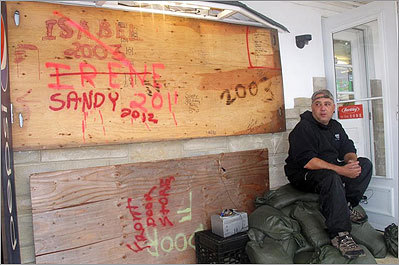
Natural disasters test our mettle and require leadership. Photo from boston.com.

As I write this, wind gusts are approaching 60 mph, and the rain continues to pelt the side of my house. Hurricane Sandy is just making landfall, but its massive power has been felt up and down the East Coast for hours. In the Washington area, there’s been flooding and downed trees. The windows shake, and trees wave frantically.

Am I ready for this?

Storms definitely test the mettle of leaders. And like a good Boy Scout, leaders are supposed to “be prepared.” I’m not talking about having enough batteries or bottled water. I’m talking about how well we respond to the unexpected and lead others through a crisis.

Leadership is not just smart contingency planning and brilliant execution under extreme conditions; it’s the willingness to assist the ill-prepared and less fortunate. It’s the ability to look past your own nose and help a neighbor or someone on your team to dry land. It’s the code of leaving no one behind, and putting others first and yourself second.

In every disaster, there are examples of unselfish and heroic efforts to save lives and property. We can’t all be heroes, but we can learn to show leadership when times seem to be their darkest.

After Katrina hit New Orleans in 2005, much was written about the lessons learned in responding to natural disasters. Point Eight Power, a firm located near New Orleans, wrote a paper describing what it calls the “five pillars” of disaster planning. Summarized below, see how many you’re practicing in your organization:

  1. People first. The first responsibility of leaders is to their people. Our primary objective was to account for our employees and their families. Were they alive? Unharmed? Safe?
  2. Communication is king. The absence of communications leaves a void in which rumor and misinformation flourish. We knew that a comprehensive and aggressive communications effort would be critical to our success.
  3. Gather intelligence. In the days immediately following the hurricane, uncertainty reigned. The need for intelligence was paramount.
  4. Manage morale. Everyone needed to see a light at the end of the tunnel. Consequently we developed a vision and enlisted everyone in our efforts to achieve it: A handful of success stories will emerge in the aftermath of Hurricane Katrina, a handful of companies who with focus, alignment and commitment will overcome the obstacles, survive and thrive. We will be one of those stories.
  5. Honor the heroic efforts. Crisis provides the opportunity for heroic efforts. We witnessed many such efforts at Point Eight Power. While many employees were selfless in acting to protect the company, a large number reached out to those outside of the Point Eight Power family. These employees focused on the less fortunate members of the community and provided shelter, food and support in many forms.

Point Eight Power notes, “Dealing with crisis made us hold a mirror to ourselves.” In the coming days, when we look back at how well we responded to Sandy, let’s hope it’s not a series of “woulda, coulda, shouldas,” but, instead, is a moment of inspired leadership and compassionate preparedness.

Posted in Leadership | Tagged , , , , | 4 Comments

Is time on your side when it comes to social media?

Do you think you can manage your social media each day in just 18 minutes?

Lisa Buyer of Search Engine Watch, picking up on the popular time management book by Peter Bregman called “18 Minutes,” suggests that it’s possible. This got me to thinking…

What strategies have you employed to manage your time on social media? Photo from time-management-central.net

Back in July, after The Wayward Journey went dark for about a month due to what I described as “social media malaise,” I got back into the game with a post called “I’m back…” In that post, I described some lessons learned from taking a refreshing pause from blogging. I returned to The Wayward Journey renewed, rejuvenated…and rarin’ to go.

And yet, I continued to have this nagging feeling that I wasn’t being as efficient at social media as I could be. That I wasn’t managing my time well. That there had to be “a better way,” a secret formula for successful social media discourse that didn’t drain valuable minutes and hours from each day.

Time management seems to be a perennial topic on social media sites, although much of what I’ve seen is directed towards those folks whose job is to mange social media for their organization. I’m more interested in the personal time people devote to Facebook, Twitter, LinkedIn and the other major online social haunts.

My guess is that we spend way too much time (i.e., obsessive amounts of time) or, in some cases, too little time to be effective.

So here are a few suggestions:

  1. Push the pause button from time to time. You don’t have to be “on” every minute of the day. Turn off the notifications. Decide which hours of the day you will devote to social media and which are for work and family. Take a day off, or a week off. You need to unplug every once in a while and take a break.
  2. Limit your engagement. Pick a platform. You do not have to engage in every form of social media that exists. Find the medium that best fits your purpose and personality and stick to that one, whether it’s Facebook, blogging or Twitter.
  3. Set a schedule. Some experts suggest devoting a set amount of time each day or week for social media. I like Lisa Buyer’s modification of Bregman’s 18-minute formula. Essentially it’s this: plan your priorities in the morning before you start working. Check them every hour to see if you’re on track. Then, at the end of the day, assess your progress. Good advice!
  4. Focus on what you want to accomplish. Stay “conscious.” That is, don’t get distracted, and don’t become a passive reader of social media. Take action! Comment on someone’s blog. Like someone’s Facebook post. Do it while you’re there, not later. Set goals for your social media presence, and then take action steps to accomplish them. Do you want to be known as an expert on green technology? Then post on green technology and make yourself known on green sites.
  5. Create meaningful interactive communities. The purpose of social media is to be social! It’s far better to have fewer followers who actually care about you than to rack up hundreds (or thousands) of fake followers. Many social media users seem to think the person with most friends or followers wins. That shouldn’t be your goal!

Oh, and one more thing: Have fun! If it becomes drudgery, turn it off.

Posted in Management | Tagged , , , , , , | 1 Comment