Don’t be a creature of habit, change your routine!

The other day I had one of those Aha! moments. It was such a small thing that at first I didn’t think much of it. But as I contemplated my “discovery,” I realized it had repercussions for other areas in my life. You might say it was a rediscovery of an age-old truth: We humans are a bundle of habits—some good and some not-so-good.

I had just taken a shower in the downstairs bathroom and was headed up two flights to the bedroom level to finish my morning routine. As I climbed the stairs, I said to myself, “Why do I do this? Why do I start my morning in one bathroom and then end up in another? Why don’t I do everything in one bathroom?”

Eating too many cookies is my bad habit.

Eating too many cookies is my bad habit.

The reason is because I’m a creature of habit. For years, I shaved and showered and got dressed upstairs in the master bathroom. But the hot water cartridge in the shower went bad. No problem, I thought, I’ll just go down the hall to the guest bathroom. But then that one went bad, too (and a plumber told me it would cost $300 per shower to fix). Undaunted, I started using the shower in the basement. It’s only temporary, I reasoned; I’ll soon get those upstairs showers fixed.

That was about two years ago.

As I thought about this one, small aspect of my life, I started to review my other habits. Why are things placed “just so” in my house and office? Why do receipts always go in that one over-stuffed drawer? Why do I put the mail on the kitchen counter and change on the dresser?

Those are just teeny, tiny habits. What about bigger habits that shape our workday or affect our relationships? As I thought about this, I noted my failure to break some fairly powerful habits in my life: eating too many snacks, failing to exercise every day, piddling around in the morning as I drink my first cup of coffee, and the list goes on.

About a year ago, New York Times business reporter Charles Duhigg wrote a best-selling book called The Power of Habit that explores the science of habits, how they work and how they can be changed.

The Power of HabitI haven’t had a chance to read the book, but luckily he’s produced this handy infographic on how to change a habit. Identifying the cues that lead to the habit you want to break is important. So is substituting new, healthier habits and creating a new routine.

As I noted in my January post “7 tips for achieving your New Year’s resolutions,” it’s important to understand the underlying motivation for our behaviors, or as Duhigg puts it, the craving that our habits satisfy. Once you understand the cues surrounding your habit (like drinking a cup of coffee first thing in the morning), you can begin to experiment with alternative rewards.

The goal is to find a healthier habit that satisfies your craving and that you can incorporate into your routine. For example, I have been experimenting with healthier foods to substitute for the junk food I love to eat.

One helpful thing you can do is to take an inventory of your habits. One of my downfalls is failing to schedule my day and succumbing to what I call piddling around. This is anything that takes me off my game, from aimlessly surfing the Internet to reading emails that probably should just go in the trash.

I’m not sure what puts me into piddling mode. Maybe I need a break from writing and should just get up and stretch. Maybe I should shift to something less cerebral like updating my calendar or paying bills. Who knows, but it’s something I’ve identified for improvement.

What habits do you need to change, and how do you plan to do it?

Posted in Goal setting, Management, Staying motivated | Tagged , , , , | 9 Comments

Is America the best place on Earth for entrepreneurs?

Is the U.S. the best place to start a new business? Image from smallbizdaily.com.

Is the U.S. the best place to start a new business? Image from smallbizdaily.com.

Now that I’m self-employed, I run into a lot of other independent business people. Call us indies or solo practitioners—we’re the ones with the big ideas and the not-so-big bank accounts. We’ve exchanged the security of a good-paying corporate or association job for the freedom to make it on our own.

And it’s okay because we live in the best place in the world for entrepreneurs, right? This is the original “rags-to-riches” republic, where anyone can start with just an idea and amass a fortune. Our business folklore is chock-full of checkered stories of hardworking, bootstrapping dreamers and schemers who made it big. It’s the quintessential American success story!

Except, it may not be true. The other day, my own “dreaming and scheming” was cut short by an article I saw on The Atlantic magazine website, “Think We’re the Most Entrepreneurial Country In the World? Not So Fast.”

Written by Jordan Weissman, it paints a sober picture of America’s place in the business startup firmament. By his account, we’re not number one, not even close by some measurements. As I read through it, crestfallen, I was reminded of those reports we hear from time to time about how America has slipped in one area or another such as math and science education, longevity or healthcare.

“Say it ain’t so!” I thought.

But Weissmann’s article is well-researched and quotes economic data that measures world business startup activity in various ways. For example, the U.S is:

  • Ranked 24th in the Organization for Economic Cooperation and Development’s (OECD) startup rate index, behind Mexico, Hungary, Italy, Lithuania, Brazil and even Luxembourg!
  • Ranked towards the middle to the bottom of OECD’s startup job creation index. Small startup firms are only responsible for a measly 2 to 3 percent of jobs in the U.S.
  • Ranked fairly high on the Global Entrepreneurship Monitor’s (GEM) “desperation index” of countries where entrepreneurs start businesses out of necessity (such as job loss) rather than desire. We’re at 21 percent compared to, say, Norway at less than 5 percent.
  • Considered merely mediocre in the innovation department when you look at GEM’s innovative products index.

But…as we all know, data can be sliced and diced in different ways. So before you pack it up and move to Denmark, consider that by these other measurements we’re still No. 1:

  • GEM’s startup activity index ranks the U.S. on top, with about 12 percent of U.S. adults running businesses that are less than three-and-a-half years old. That’s nearly twice the world average of 6.9 percent. GEM’s survey counts all businesses, even those that don’t have a payroll. So this would include self-employed individuals, who make up a large part of America’s working population.
  • The U.S. ranks among the highest in LLC startups, according to the World Bank.
  • The U.S. is ranked No. 1 in the Global Entrepreneurship and Development Index (GEDI). The GEDI ranks 79 countries for entrepreneurial performance, and the U.S. topped the 2012 GEDI index. The creators of the GEDI, professors Zoltan Acs and Lazslo Szerb, note that other indices such as GEM’s and the World Bank’s have many shortcomings, so they created a more complex measurement. (Incidentally, Denmark was No. 1 in 2011.)

Regardless of which data you go by, the U.S. is still a very good place to start a new business. The GEDI says the U.S. received the highest score for two important factors: “a very well developed institutional business environment with low levels of business risk (1.00) and a high level of urbanization and domestic market size (1.00).” I’m not sure what that means exactly, but I think it’s a good thing for entrepreneurs!

Posted in Entrepreneurship | Tagged , , , , , , , | Leave a comment

Love, leadership and Valentine’s Day

LoveFlip through radio stations or your own collection of CDs and MP3s, and I bet every other song will be about some aspect of love or romance. Looking for love, falling in love, falling out of love, breaking up, getting back together—the songs we listen to are predictable, yet expressive of universal yearnings to love and be loved.

Valentine’s Day is the one day where it’s “okay” to recognize love, albeit in ways that are often crassly commercial or entirely superficial. But at least we make a stab at it. I’m not one for expressing myself much in the emotions department, but even I can get sentimental at times.

But what is love? Is it just a “secondhand emotion” as the song says? Or is it something bigger? And how can we make it last longer than just the one day of the year when we give each other cards and eat heart-shaped candy?

The words of Paul in 1 Corinthians 13 have been quoted often, but I can think of no better description of the kind of lasting love we need—more than any song about Cupid or heartbreak.

“Love is patient, love is kind. It does not envy, it does not boast, it is not proud. It does not dishonor others, it is not self-seeking, it is not easily angered, it keeps no record of wrongs. Love does not delight in evil but rejoices with the truth. It always protects, always trusts, always hopes, always perseveres.”

Those words, written several millennia ago, still ring true today, and they find their way into modern tomes about relationships, management and leadership. Humility, patience, kindness, generosity, empathy and trust are attributes we admire in leaders but are sorely missing in many workplaces.

“Leading with love” is not about feelings or emotions; it’s about behaviors and their consequences, and recognizing that character matters. It’s about putting others before our own selfish needs. In fact, rarely does great leadership exist without love.

On this Valentine’s Day, in addition to honoring the person who is the love of your life, why not vow to also “love” the way that Paul suggested? It couldn’t hurt.

Posted in Leadership, Purpose | Tagged , , , , | 6 Comments

Why is delegating so hard? Let me count the ways

I am not the best at delegating. And judging by the volume of “how-to” articles on this subject in journals like HBR, I’m not alone. Many executives and leaders fall down when it comes to delegating—and ultimately it can harm their career and organization.

It seems that the very traits that make us successful—up to a point—also prevent us from letting go of even the most menial assignments and trusting others to do a good job on our behalf.

delegating

Why is it so hard for us to hand off work to others? Photo from leadershipfreak.wordpress.com.

Think about it: You’ve risen to the top of your organization by dint of hard work and tenacity. You’ve proven that you not only “know your stuff” but can “get the job done.” How likely are you to give that up, especially if you feel that others around you are incapable of producing at the level you or your bosses expect?

In reviewing my own management experiences and watching others, I’ve identified four “delegation blockers” that I find common among managers. How many of these are you guilty of?

  • “No time to train my staff. I need to do it myself this time. When there’s some downtime, I’ll show someone else how to do it.”
  • “No one else knows this like I do, so it’s just easier for me to do it.”
  • “You gotta be kidding! These people are bozos. No way I’m going to give them something as important as this to work on. They’ll just mess it up, and then I’ll have to fix it.”
  • “Where’s my value if I give all the ‘good stuff’ to my staff to work on?”

At the core of these excuses are some rather vain assumptions: “I am important and valuable; others around me are not. In fact, they are downright incompetent, whereas I am perfect.”

This kind of thinking does not lend itself to enlightened leadership. An enlightened leader understands one of the great paradoxes of life: The more you give up, the more you gain. People will never meet your expectations if you don’t treat them as you would expect to be treated.

In watching good leaders and natural delegators, I’ve observed a few best practices. Try some of these and see what happens:

1. Take the time to teach. Delegators understand the importance of learning. They are willing to invest in training and ensure their staff has the tools to do the job right. Control freaks take a dim view of professional development and often see it as a waste of time.

2. Trust. Trust has a funny way of bringing out the best in people. Think about the first time you were entrusted to do something, whether it was driving a car by yourself, preparing a report or leading a meeting. Didn’t you work extra hard to prove yourself? Give your staff a chance to do the same.

3. Communicate clearly. Make sure the person to whom you are delegating has a clear sense of your expectations—the scope of work, deadlines and deliverables.

4. Do not micro-manage. Give your staff some elbow room. Create reasonable expectations, establish sensible benchmarks, then leave them alone to do their job.

5. Build up people in meetings. Take advantage of meetings to recognize and reward good work.

6. Give credit freely. Praise others whenever you have the opportunity. It does wonders for morale and self-esteem.

Posted in Careers, Leadership, Management | Tagged , , , , | 2 Comments

Snow-deprived in D.C.

Here in D.C., it’s sunny and clear in the Land of Unsnow. Up north, it’s wall-to-wall snow; it’s our Snowmageddon of a few years ago times two.

The unsnow moved into the D.C. area early this morning and blanketed everything in…bright sunshine. Here’s my car covered in a thick layer of unsnow, barely recognizable. It took me hours to clear off.

The unsnow moved into the D.C. area early this morning and blanketed everything in…bright sunshine. Here’s my car covered in a thick layer of unsnow. It took me hours to clear it off.

There’s something invigorating, adventurous and enchantingly childlike (unless you’re stranded in an airport) about large amounts of fresh snowfall. It blankets everything, causing the familiar to take on new shape, adding beauty to where there was nothing but blandness. Best of it all, it brightens the tired, dreary winter landscape, whitening an otherwise gray, drab day.

It gets you outside, talking to neighbors, digging out cars, shoveling driveways. Working up a sweat, going inside to warm up with hot cocoa and then returning to dig some more. Sledding down hillsides. Taking walks. And, yes, if you are foolish enough, slipping and sliding along unplowed roads and biting your nails all the way.

Here in D.C., we’ve received a grand total of 1.5” of snow this year, continuing our “snow drought” of 744 days.

So we watch on TV or read online about the storm in New England, living vicariously the wonder, awe and shock of three feet of snow! Three feet of snow!

Of course, there is the cleanup, the power outages, closings, pileups on the Interstates and, sadly, a few deaths. Our hearts go out to everyone affected; but I have to say, a little part of me is disappointed. Where’s our snow?

Dust of (Un)Snow

The way a crow
Shook down on me
The dust of (un)snow
From a hemlock tree

Has given my heart
A change of mood
(I’ll go to Walmart,
Look at shovels…and brood.)

– Robert (Un)Frost

Posted in Happiness | Tagged , , , , | 5 Comments

‘What is it you do again?’ or how to explain the indie life

Image from rebelbadges.co.uk.

Image from rebelbadges.co.uk.

It’s surprising how you can be working in the same profession, doing the same kinds of things you’ve always done, but if you’re not attached to a company you become an enigma in the minds of many. Organizations help define who we are, so if you sever those ties to pursue fame and fortune on your own terms—well, that’s gotta be a lark or just pure craziness, right?

So I often find myself explaining—unsatisfactorily, it seems—what exactly it is I do all day long. I’m an independent public relations consultant or “indie”; but I find it easier sometimes to simply describe the projects I’ve worked on for clients or say that I own a small business, which as an LLC I technically do.

Luckily, there’s a group called the Independent Public Relations Alliance (IPRA) that does a better job than I could of explaining the independent practitioner’s story and the virtues of hiring an independent pro to do your PR and marketing.

A couple of months ago, past IPRA Chair Shawn Flaherty had a guest post on the PRSA-NCC blog that I thought made the case pretty persuasively for considering someone from our network, a group of 63 entrepreneurs in the D.C. area who own their own small or solo PR firms.

These indies have impressive credentials, with experience in many disciplines and industry sectors. In fact, many held leadership roles in corporations, nonprofit organizations and government agencies before starting their own businesses.

These seasoned pros average 24 years of experience, nearly half have advanced degrees, and many hold APRs, according to IPRA’s October 2012 member survey.

Most indies offer full-service PR—which includes strategic communications planning, issues management, writing, branding, media relations, speechwriting, social media and marketing. Many have specialties by issue area, skill and industry.

This year, I have the pleasure of serving on IPRA’s board and working on its program committee. The new board met yesterday for its kickoff meeting, and one of the topics that came up is how to better promote our services and create awareness for the indie model. One way, we decided, is for us to talk it up in our own networks and blogs.

I joined IPRA a year ago and found it an invaluable resource as I transitioned from full-time employment to self-employment. Nothing helps to ease the anxiety of a new venture, especially when you are flying solo, than the support of like-minded colleagues and friends. IPRA meets that need in spades, but it also provides professional development to help its members improve and earn more business.

There is increasing evidence that more Americans are leaving regular jobs for their own gigs as “solo-preneurs.” That’s due to many factors, including fewer traditional, high-paying jobs, Baby Boomers exploring second careers and a desire among people of all ages to better balance their work and life goals.

A few weeks ago, I wrote about Ford’s “13 trends for 2013” and noted the rise of “do-it-yourselfers.” Among the statistics Ford cited is the fact that we have become a “freelance nation” with 42 million freelancers, including a growing number of lawyers, journalists, videographers and accountants. So I guess my IPRA colleagues and I fit right into this trend!

Related posts you may have missed

Posted in Careers, Entrepreneurship | Tagged , , , , , | Leave a comment

Add one more to the pile of discarded technology

What no iPod owner ever wants to see.

What no iPod owner ever wants to see.

My first and oldest iPod died last week. The dreaded Sad iPod icon appeared on the screen, and that means either I dispatch it to the boneyard of discarded technology or I pay Apple more than it’s worth to fix.

I can’t say that I was surprised it bit the dust, considering its relative age (purchased in late 2005) and that I have dropped it more than a few times. Known originally as the Fifth Generation iPod and still sold today as the Classic iPod, it was the first to feature video capability. It also has a hard drive, making it a handy digital storage device.

To be honest, I haven’t used it much since purchasing an iPod Touch two years ago. But with 60GB of space, it was the main repository for a lot of my music. And most of that music, unfortunately, wasn’t backed up on a PC. That’s because I preferred to keep the original music on CDs.

So what was once a bright shiny toy is now a candidate for recycling. I can remember being so careful about protecting its screen. This particular model was notorious for getting scratches. I think that’s when the iPod case industry took off because we all had to buy protective coverings for our beloved iPods.

I can also remember spending hours downloading and watching the first video podcasts. It seemed like everyone was making podcasts and uploading them to iTunes. I soon had my favorites—an oddball comedy troupe from L.A. called “The Ministry of Unknown Science,” Marco Tempest, “the Virtual Magician,” and an artsy podcast called “Four Eyed Monsters.” I was also a big fan of many audio podcasts, including the “Word Nerds,” a weekly show by two English teachers about words, language and grammar.

What to do about the world's growing pile of discarded electronics?

New technology spurs new applications, but what do we do with the old stuff? Photo from engadget.com

Most of these early podcasts have ceased production. My listening habits have changed since then, too. I have XM Radio in the car and Pandora on my PC. If I want to hear a particular song, I’m likely to first search for it on YouTube. Often, that is all I need to satisfy my curiosity or my “quick fix” for that tune.

Each new technological development spurs its own cottage industry of enthusiasts and early adopters. And after the first wave, those pioneers move on, paving the way for mainstream commercial applications. When I purchased my iPod Touch, I was surprised at how quickly I abandoned my old “auditory” habits. With its WiFi capability, the iPod Touch became an extension of my computer, allowing me to view email and surf the Internet. Listening became secondary.

And then there are the apps. Don’t get me started on those. I could spend a lifetime downloading and trying out apps.

It’s hard to believe the technologies of just a few years ago are already being cast aside. We lived for decades with LPs, then along came tapes, CDs, MP3s and streaming audio in quick succession. So what’s next?

It’s hard to say, but one thing’s for sure: the graveyard is getting bigger. It’s estimated that in the next five years, about a billion computers around the world will be discarded. Here in the U.S., we toss out 30 million computers each year. In Europe, it’s estimated they throw away 100 million cell phones a year.

For now, I plan to keep my iPod. I can’t bring myself to throw it away just yet. Perhaps I will have it mounted as a curiosity—or donate it to the Smithsonian.

Posted in Technology | Tagged , , , , , | 4 Comments

5 keys to better time management in your organization

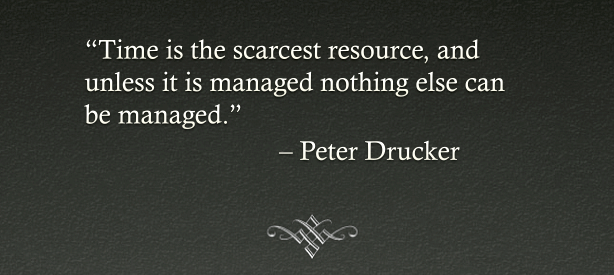
Drucker time quote

Perhaps you made it a New Year’s resolution to better manage your time. If you did, you’re not alone. I have wrestled with time management for most of my career, always feeling I still have more to do at the end of the day. There never seem to be enough hours to get things done, right?

Struggling to complete projects, stay on top of new trends and lead a staff can be daunting for managers, and most, according to a survey from McKinsey & Company, feel they are falling behind. But what’s particularly insightful about McKinsey’s research is the conclusion that “[t]ime management isn’t just a personal-productivity issue over which companies have no control; it has increasingly become an organizational issue whose root causes are deeply embedded in corporate structures and cultures.” (See “Making time management the organization’s priority” by Frankki Bevins and Aaron De Smet in the latest McKinsey Quarterly.)

The problem is that few organizations treat their executives’ time as a finite and measurable resource. According to Bevins and De Smet, leadership time “too often gets treated as though it were limitless, with all good opportunities receiving high priority regardless of the leadership capacity to drive them forward.”

looking at watch

Does your organization use time effectively?

The authors give examples of overextended executives being given even more assignments without any consideration of the time it will take to complete the new projects. Does this sound familiar? As a result, even the most skilled people are so overloaded that they lack the capacity to lead crucial new programs.

The proliferation of big strategic initiatives and special projects has led to “initiative overload,” says McKinsey. “[P]rojects get heaped on top of ‘day jobs,’ with a variety of unintended consequences, including failed initiatives, missed opportunities, and leaders who don’t have time to engage the people whose cooperation and commitment they need. Organizations often get ‘change fatigue’ and eventually lack energy for even the most basic and rewarding initiatives.”

What’s the solution?

Judging by the “satisfied” executives in the survey (those few who actually got things done!), the key is balancing your time. These execs spent about a third of their time interacting with external stakeholders, 39 percent in internal meetings and another 24 percent working alone. They tended to divide their workday evenly among: making key business or operational decisions, managing and motivating people, setting direction and strategy, and managing external stakeholders. They also spent less time on administrative tasks.

More specifically, here are five recommendations from McKinsey that all leaders and managers should consider:

  1. Have a “time leadership” budget—and a proper process for allocating it. As McKinsey puts it, how much leadership capacity (time) does your company really have to “finance” its great ideas? In other words, treat human capital the same way as financial capital.
  2. Think about time when you introduce organizational change. That is, how much time is it really going to take to achieve the organization’s goals?
  3. Ensure that individuals routinely measure and manage their time. McKinsey discovered (surprise!) that while most executives can tell you how much of the budget is dedicated to their organization’s priorities, they often don’t have a clue about how much time is devoted to them. Time also gets misallocated when employees spend too much time on measurables that aren’t aligned with strategic objectives. McKinsey recommends putting time-related metrics in managers’ performance reviews to keep them focused on what matters most to the company.
  4. Refine the master calendar. Not only should organizations keep a master calendar, but they should use it to root out corporate time-wasting such as unnecessary meetings.
  5. Provide high-quality administrative support. McKinsey found that effective time managers receive strong administrative support. The CEO, in particular, needs to have a capable admin who can “own” the master calendar and ensure that the executive team’s time in meetings is devoted to the organization’s priorities.
Posted in Leadership, Management, Organization | Tagged , , , | 2 Comments

13 trends for 2013, courtesy of Ford Motor Company

Ford 13 trends for 2013Last month, Ford released its first-ever trend report, “Looking Further with Ford: 13 Trends for 2013.” Aside from a story in USA Today, it was mostly picked up in auto trade publications. That’s a shame because it contains some intriguing insights into consumer buying habits as well as interesting social, technological, economic and environmental trends.

To be sure, Ford does a good job of inserting itself into the equation. It pats itself on the back in several places for its innovative, fuel-efficient cars. But I highly recommend a download of the report. It has an infographic look, with lots of icons, charts, mini-case studies and cool typography.

I’ve always worked at small firms where market research comes at a premium. So it’s impressive to me that Ford has a staff of full-time trend researchers who collaborated “with thought leaders from around the world to provide a comprehensive look at the major consumer trends expected to influence products and brands in the coming years.”

In it’s intro, Ford writes that “after a half-decade of disheartenment…consumers are ready to trust again.” But this time, Ford says, our trust is not in institutions, but in ourselves and in “the things that we believe to be real and truthful.” Okay, I’m all for that.

Here are the three big takeaways from the report:

Trust as a differentiator: Given its relative scarcity, trust is emerging as a key positive differentiator for brands. Correlation of trust to brand equity has increased by 35 percent since 2009. As a result, brands are having to rethink how they communicate with and reveal themselves to consumers—the more real and authentic they are, the better.

Personal accountability is on the rise, and with it, a comfort with failure: 80 percent of adults globally disagree that “there is little I can do to change my life” and 82 percent say that having and admitting failures is critical to overall success. As a result, they are taking risks, blazing their own paths and reshaping conventions.

Collective empowerment is booming: As consumers accept more personal accountability, they are also learning to rely on each other for support: 80 percent say discussing goals and objectives with others makes their targets easier to achieve. And they are recognizing that their individual small acts can, in the aggregate, make a big impact on society, which is perhaps why 85 percent agree that “problems are better solved by local communities than the national government.”

Ford identifies 13 trends that support these three themes. Trend #5 is called “The Micro Skills DIY.” I personally like this one because I have always been a do-it-yourselfer (DIY). I just didn’t know it was trendy. From remodeling the homes I’ve lived in to building my own company website, I’ve always preferred to do it myself.

Of course, DIY requires developing skills that you may not have had before. Ford describes how technology has facilitated this, reducing the learning curve and making new skills more accessible. As a result, we are starting to shift away from the notion of linear expertise—rather than just refining one set of skills, we are looking to expand them and leverage them.

Another trend I like is called “The Minimal Maximist.” As Ford puts, it, “mindless consumption is becoming more mindful—we are re-entering an era in which quality trumps quantity.” As a result, consumers are going through a “consumer cleanse— cutting back on stuff for stuff’s sake and demanding that the things they own or buy work harder for them.”

In one survey that Ford cites, 65 percent of the respondents said that “since the recession, I realize I am happier with a simpler, more down-to-earth lifestyle.” Hence, the rise in green living and the sharing and resale of used items.

Below are all 13 trends. Download the report, and see which ones you identify with!

  1. Trust Is the New Black
  2. Consumer Republic
  3. Get Real
  4. Pioneering Pathways
  5. The Micro Skills DIY
  6. Help Me Help Myself
  7. The Economics of Local Pride
  8. The Rise of the Intima-City
  9. Defying Distraction
  10. The Minimal Maximist
  11. Return to Your Senses
  12. Forever Young
  13. Post-Green
Posted in Marketing | Tagged , , , , , , , , | 4 Comments