Keep your head in the clouds and your feet on the ground

Meadow with flowers

Are you a dreamer or a doer? Hopefully you are a little of both.

Years ago, when I was working at a DC trade association, the CEO stopped by my office one night before heading out the door.

“Why do businesses fail?” he asked me.

I could think of many reasons, but I knew there must be one in particular that was on his mind.

“Because they can’t execute.”

Earlier in the day, we had been brainstorming a new project that would take a lot of staff time and resources, so I knew where he was headed. The upshot was that he was killing the project before we even had a chance to get it off the whiteboard.

As I drove home that night, I had mixed feelings. I was disappointed that we weren’t doing the project, but I was also relieved because I wasn’t sure we could actually pull it off.

When I was a kid, my parents used to say that my eyes were bigger than my stomach when I put more on my plate than I could eat.

There have certainly been times in my life when I’ve bitten off more than I could chew. Haven’t we all faced situations where we feel we can’t possibly get everything done that we’ve volunteered or been asked to do? Especially nowadays when everyone is working harder yet still expected to meet those elusive stretch goals.

I have a lot of admiration for visionary thinkers, but I have even more admiration for thinkers who can deliver on their promises. Few people are good at both dreaming and doing.

Teddy Roosevelt once said, “Be practical as well as generous in your ideals. Keep your eyes on the stars, but remember to keep your feet on the ground.”

That’s good advice. Along those same lines, Mike Robbins wrote a good blog post a few years ago about keeping your head in the clouds and your feet on the ground.

It starts with recognizing where you are in the cloud vs. ground spectrum. It’s tough balancing the practical with the visionary. My days are often filled with the humdrum stuff that goes into running a solo practice. Not to mention meeting client deadlines.

The big picture gets left in the weeds. How to expand the business, get new clients, maybe develop a new specialty area—it always seems to fall off my to-do list as I get busy.

Robbins says that we should allow ourselves to focus on our dreams. “Having our ‘head in the clouds’ is about giving ourselves permission to dream and dream big,” he says.

But we also have to take intentional and effective action. “One of the biggest challenges we encounter in our journey towards our dreams is either not taking effective action (because we don’t know what to do or we’re too scared to do it) or taking too much ineffective action (because we’re running around crazy or acting in an unconscious way),” he says.

According to Robbins, “When we allow ourselves to dream big (with our ‘head in the clouds’), how we keep our ‘feet on the ground’ is by coming up with intentional and appropriate actions to move forward with our goals, even if we’re scared and not sure how things will turn out.”

It’s also important to get support and feedback. As Robbins puts it, “[A]ll of us need people who can cheer for us, hold us accountable, and support us on our journey in an authentic and meaningful way. We can’t do it alone—well, at least not nearly as easily or effectively.”

Finally, he suggests not getting too stressed or uptight about meeting goals. “Having fun along the way ensures we keep things in perspective and enjoy the ride, regardless of the outcome.” When we’re able to both dream and execute with passion, intention and focus, “we create a sense of balance and peace that can allow us to have what we truly want in life.”

How about you? How are you balancing the “vision thing” with getting things done?

Posted in Goal setting, Happiness, Management | Tagged , , , , | 4 Comments

The seven habits of highly effective enterprises

McKinsey & Company published a short article a couple of weeks ago that is long on leadership and organizational insight. “The seven habits of highly effective digital enterprises” by ’Tunde Olanrewaju, Kate Smaje and Paul Willmott is worth a read, with observations and examples about how companies are successfully transforming themselves in the digital age. What struck me is that nearly every one of the seven habits applies to all aspects of business, whether you’re digitally engaged or not.

In fact, I think if you just delete the word “digital” from the title, you’d have a good template for organizational success. So here are the seven habits. See how many of these you are doing.

  1. Be unreasonably aspirational. “Being ‘unreasonable’ is a way to jar an organization into seeing digital as a business that creates value, not as a channel that drives activities,” say the authors. Bean Samples The Ocean of StormsAs I considered the examples given—Burberry and Netflix—I couldn’t help but think of Jim Collins and Jerry Porras’ Built to Last: Successful Habits of Visionary Companies. The companies that are able to envision a future are the ones that succeed. They aspire to become or create something that may not even exist or be achievable—at least not by current thinking. As the article notes, Netflix was a successful renter of DVDs, but it aspired to become a leader in a technology that was only in its infancy—streaming video. At the end of last year, NetFlix had 40 million streaming subscribers. Not bad for a bunch of dreamers.
  2. Acquire new capabilities. Here the authors deviate a bit from everything you always heard about hiring for attitude, not skills. But if you want digital transformation, you need people who have proven digital skills. This is the “acqui-hire” approach that you’ve seen tech giants like Apple, Google and Facebook adopt in recent years when they acquire small start-ups to fill in the gaps they have in their own talent pool. Of course, not everyone can go out there and buy a whole company just to get a few talented people. But I think McKinsey is right in saying that talent can be mighty important, especially in the early stages of transformation.
  3. “Ring fence” and cultivate talent. McKinsey found that the most successful digital transformations occur when companies fence off their digital groups from the rest of the organization, protecting them from “business as usual” and giving them free rein to innovate. fence“Digital talent must be nurtured differently, with its own working patterns, sandbox and tools,” McKinsey says. The question is, how long do you let the digital team operate as its own skunkworks? “To deliver in an omnichannel world, where customers expect seamless integration of digital and analog channels, seamless internal integration should be the end goal,” the authors suggest. In other words, in the beginning it makes sense to build a separate digital team and give them what they need, but eventually they need to be integrated into the organization. That’s not just a model for digital. Any new, important project can benefit from the same approach.

  4. Challenge everything. “Look at how everything is done,” says McKinsey, “including the products and services you offer and the market segments you address, and ask ‘Why?’ Assume there is an unknown start-up asking the exact same question as it plots to disrupt your business.” Apple is often cited as a transformational model, moving from computer maker to one of the largest distributors of music, not to mention reinventing the cell phone and the way we use mobile devices. After all, it was Steve Jobs who said that leaders are always deeply dissatisfied with the status quo, restless for change and impatient for progress. “Digital leaders examine all aspects of their business—both customer-facing and back-office systems and processes, up and down the supply chain—for digitally driven innovation,” McKinsey says.
  5. Be quick and data driven. “Rapid decision-making is critical in a dynamic digital environment,” the authors write. “Organizations need to move to a cycle of continuous delivery and improvement, School testadopting methods such as agile development and ‘live beta,’ supported by big data analytics, to increase the pace of innovation. Continuous improvement requires continuous experimentation, along with a process for quickly responding to bits of information.” Examples include companies like U.S. Express that collects data in real time from tens of thousands of sources and then uses business-intelligence tools to extract insights about its fleet operations. P&G is another example. It provides up-to-date sales data across brands, products and regions to more than 50,000 employees globally.

  6. Follow the money. “A digital transformation is more than just finding new revenue streams,” says McKinsey. “[I]t’s also about creating value by reducing the costs of doing business.” The authors say that while testing and experimentation is critical, “teams must quickly zero in on the digital investments that create the most value—and then double down.” Often, the authors report, great value is found in optimizing back-office functions. They give the example of Starbucks, where only a third of its active IT projects were focused on customers in 2013. One-third of its projects were devoted to improving efficiency and productivity, and another third focused on improving resilience and security.
  7. Be obsessed by the customer. No surprises here, but it certainly bears repeating: “A healthy obsession with improving the customer experience is the foundation of any digital transformation.” I would say that goes for any business transformation. Customer Service OperatorAs the authors note, “Rising customer expectations continue to push businesses to improve the customer experience across all channels. Excellence in one channel is no longer sufficient; customers expect the same frictionless experience in a retail store as they do when shopping online, and vice versa.” What’s key is the ability to learn from every customer interaction. Successful companies are obsessed with getting the experience right and using digital to fine-tune interactions. As the authors state, “This mind-set is what enables companies to go beyond what’s normal and into the extraordinary. If online retailer Zappos is out of stock on a product, it will help you find the item from a competitor. Little wonder that 75 percent of its orders come from repeat customers.”
Posted in Leadership, Management, Technology | Tagged , , , , , , , | 1 Comment

Is business dynamism on a permanent decline?

Last year I wrote a post (“Is America the best place on Earth for entrepreneurs?”) that looked at some worrisome trends suggesting a decline in U.S. entrepreneurship. This was based on data compiled by the Organization for Economic Cooperation and Development and the Global Entrepreneurship Monitor (GEM) that ranks countries on startup rates and innovation.

Business dynamism - Brookings Institution

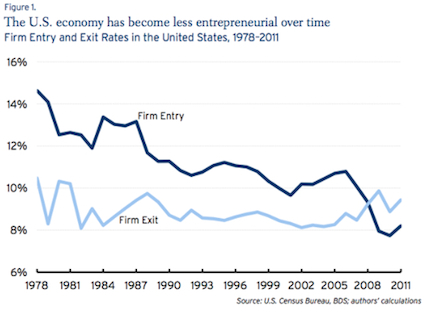
Graph showing decline in business dynamism from Brookings Institution.

Now comes a troublesome new study from the Brookings Institution by economists Ian Hathaway and Robert Litan that says more businesses are dying than being created in the U.S.

Hathaway and Litan analyzed business dynamism over a 33-year period (1978-2011) and concluded that dynamism is slowing down in all 50 states and nearly every metropolitan area, to the point where firm exits exceed firm entries.

As the two explained in their paper:

Business dynamism is the process by which firms continually are born, fail, expand, and contract, as some jobs are created, others are destroyed, and others still are turned over. Research has firmly established that this dynamic process is vital to productivity and sustained economic growth. Entrepreneurs play a critical role in this process, and in net job creation.

But recent research shows that dynamism is slowing down. Business churning and new firm formations have been on a persistent decline during the last few decades, and the pace of net job creation has been subdued. This decline has been documented across a broad range of sectors in the U.S. economy, even in high-tech.

While the reasons explaining this decline are still unknown, if it persists, it implies a continuation of slow growth for the indefinite future, unless for equally unknown reasons or by virtue of entrepreneurship enhancing policies (such as liberalized entry of high-skilled immigrants), these trends are reversed.

Many commentators were quick to insert their own explanations for the decline, such as increased government regulation, or complain about “Obamanomics.” But in an interesting follow-up to their study, Hathaway and Litan noted that the decline has been steady, spanning both Republican and Democratic administrations, and that there really is no clear explanation—yet—for what is happening.

Being self-employed, I take a greater interest in these things than I once did, and I have to wonder if sole proprietors are counted as firms in the research. That may have some bearing, especially in light of several other employment trends that are beginning to have an impact on our economy:

  • Last year, I also wrote about the rise of the freelance nation. According to Ford Motor Company’s “13 Trends for 2013,” there are now 42 million freelancers in the U.S. As Ford noted, “Today’s contract workers are lawyers, journalists, daycare workers, graphic artists, accountants, videographers…” Ford calls this trend “The Micro Skills DIY” and says, “Versatility, nimbleness and agility are necessities in today’s shifting economic climate, where staid manufacturing jobs have been replaced by fast-moving technological ones.”
  • I recently was doing research for a client white paper and was fascinated by another employment trend known as encore or second-act careers. Baby Boomers, in particular, are eschewing the normal retirement path and deciding to continue working, only they want to do something more meaningful the second time around. The MetLife Foundation says as many as 31 million people between the ages of 44 and 70 are looking for encore employment that combines meaningful work with social impact and continued income. Many of these encore careers involve starting a business or nonprofit.

It would seem to me that these two trends might counterbalance the slump in business dynamism that the Brookings study describes. However, it may be that something more structural is going on. Let’s hope dynamism is simply in a state of flux, in which case, we might see some improvement in the coming years.

Posted in Entrepreneurship | Tagged , , , , , , | Leave a comment

Just 30 minutes a day

Tennis shoes

Still Life of Tennis Shoes

Today I pushed myself further than ever before in my exercise regimen. I turned on the treadmill.

Actually, I’m getting better about exercising. I won’t go so far as to say that I like exercise, but we’re doing okay. Sure, we’ve had our differences over the years. There were times when I told exercise to get lost, but I always came crawling back. There were times when I was overly obsessed with exercise, but I got past that, too.

Now, it’s just a simple, steady relationship, more or less the equivalent of a heart-healthy routine of walking 30 minutes a day.

You joggers and marathon-runners are laughing, I bet. But there are lots of studies that show walking just 30 minutes a day (sounds like a TV commercial, I know) has huge physical and mental health benefits.

The health benefits alone are pretty amazing. You can increase your cardiovascular fitness, strengthen your bones, reduce body fat, improve blood pressure and boost endurance just by walking! Walking can also reduce your risk of developing heart disease, type 2 diabetes, osteoporosis, and breast and colon cancer.

The American Heart Association says walking is “the simplest positive change you can make to effectively improve your heart health.” I believe it!

I need only look at my dad, who will turn 90 later this year, to see the benefits. Every morning, except Sundays, he gets up early and walks 2-3 miles with his walking club at Greenspring. They walk year-round. Even his bum knee hasn’t deterred him from his walking.

Now that’s inspiration!

But, wait, that’s not all, as they say on late-night TV. There are even more benefits to walking!

You feel better. Studies show that walking results in a better night’s sleep. It decreases stress, improves your memory and boosts your mood. It gets you out of your work routine. It helps you clear your head and focus.

Mason Currey, who wrote “Daily Rituals: How Artists Work,” discovered that many famous creative people had a habit of taking daily walks. A lot of composers took walks, including Beethoven, Mahler and Tchaikovsky.

I find that ideas for this blog pop into my head when I’m exercising, or maybe the solution to a problem I’ve been wrestling with will come to me. It’s great for boosting creativity.

Of course, what gets me are all of the bad things I eat. I never met a cookie, brownie or bag of chips that I didn’t like. So good exercise habits have to be supported by healthy eating habits and a good night’s rest. If you can get those three in balance, there’s a strong possibility that you could live as long as a . . . famous composer?

No, you really don’t want to live as long as a famous composer. Trust me, they had short lives. I’ve already outlived Beethoven, Mahler and Tchaikovsky.

Poor Tchaikovsky. Currey reports that the composer walked precisely two hours each day. Tchaikovsky feared that if he finished his walk just a few minutes early, a great misfortune would befall him. I guess he was right because he died at age 53. Some say it was from cholera, others say he killed himself. I say it’s because he should have walked just 30 minutes a day.

Posted in Goal setting, Staying motivated | Tagged , , , , , , | 2 Comments

Life goes on…and that’s a good thing

Meadow

Straight from Central Casting: A meadow suitable for running through with outstretched arms. (freerangestock.com)

Three months have gone by since I last posted here at The Wayward Journey. As the days and weeks passed, I imagined a great celebration in the blogosphere the day I finally pushed the “publish” button again.

The music would cue up, the sun would shine, and I would run through a golden meadow with outstretched arms.

The world’s greatest bloggers would all be there, cheering me on, giving me atta boys and high fives as I reached the end of the field. The music would crescendo to a rousing conclusion as I unfurled with great fanfare and beaming pride my New Post.

Bravo! Bravo!

Okay, cut. That’s a little too Hollywood, even for a dreamer like me. But I did anticipate that this first post in months would be special, something suitable for framing, as we used to say in the pre-digital days.

Friends and a few followers asked, “When will you blog again?”

“Soon,” I said, thinking that I would surely get something posted. After all, it’s not like we bloggers lack for material. Even the most mundane experience, in the hands of a resourceful writer, can become the subject of a brilliant homily.

And though I’ve had many experiences over these past few months that I could have blogged about, I did not get to them, obviously. I got busy, and The Wayward Journey went dark.

Oh, I’ve been writing all this time, that’s for sure. In February, March and April, I wrote like a madman on several big projects for Jay Morris Communications. After all, that’s what pays the bills. Like a horse that’s been ridden too long, I was all wrote out. After a full day of writing for clients, I would say to my blog, “Tomorrow, I’ll get to you tomorrow.” I was spent, so my blogging got put on hold.

Then weeks went by, and pretty soon when I visited The Wayward Journey, it was like looking at an old yearbook or walking through a graveyard. I began to wonder if the Journey was over. Had I said all that I had to say? Was this blog going the way of so many other blogs—launched with great enthusiasm, then left to languish in cyberspace like a spent rocket?

No, I had a hunch I’d be back because this is The Wayward Journey, with a capital W. But when those old creative juices finally began to stir, I decided that I didn’t want my first post back to be my usual fare—stories about everyday life that when examined from a different perspective yield new insights. Although, that does sound pretty good, doesn’t it?

Garden

I could be blogging about trimming bushes!

For example, on Saturday, I spent the day trimming bushes and trees. I’m sure I could give you 500 words on the importance of careful pruning, why it’s necessary to cut out those things in life that impede our growth so that we can be more fruitful. I could quote the Bible even, John 15:2: “He cuts off every branch in me that bears no fruit, while every branch that does bear fruit he prunes so that it will be even more fruitful.”

I wanted to write something more, though, something epic! Something so poignant, so pregnant with meaning, that readers would literally swoon. Babies would stop crying, politicians would stop bickering, warring countries would stop fighting. The stock market would explode with approval, and my retirement savings would mushroom overnight. For once, I could look at those annoying Internet ads—the ones that ask, “Do you have $500,000 to invest?”—and say, “Yes I do, and it’s all because of my blog!”

And so here you are, having read this far, and I’m guessing you’re not swooning, the stock market is still sputtering and babies are crying. C’est la vie, right?

Sometimes a blog about trimming bushes isn’t a bad thing. Because trimming bushes is real, and it needs to be done. Robert Frost once said, “In three words I can sum up everything I’ve learned about life: it goes on.”

Yep, it does. We live through life, and we draw what we can from it. A moment savored, a photo shared, a lesson learned. We raise a glass and toast each other for making it through another day, another year, another birthday or anniversary.

I made it through these last three months, and I’m here. I can’t say that I have anything terribly profound to impart, but I’m glad to be back in the saddle.

I’d like to think there was someone out there nudging me a little, secretly giving me a kick in the butt to get back to it. We all need someone who believes in us when we’re tired and don’t think we can go any further. Even the Desperado in the Eagles song had someone looking after him. To those folks who knew that I would eventually come down from my fences, thanks!

So I’m back, at least for a little while. Long enough to catch up and have a Corona—or two. Long enough to see what you’ve got in the refrigerator, maybe stay for dinner.

Oh, and those chocolate-chip cookies you had on the counter, I only ate two. I swear.

Posted in Careers, Staying motivated | Tagged , , , , | 4 Comments

Why the Beatles were so good: They practiced!

Beatles in America

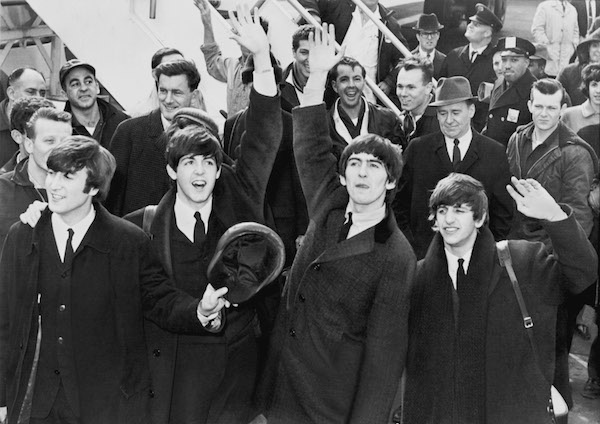
The Beatles arrive in America in 1964. From left to right: John Lennon, Paul McCartney, George Harrison and Ringo Starr. Photo from Library of Congress and Wikimedia Commons.

Last week, Washington celebrated the 50th anniversary of the Beatles’ first concert in America with the tribute band Beatlemania Now taking the stage at the same venue (the Washington Coliseum) at the same time (8:31 p.m.) to play the same set (12 songs) that John, Paul, George and Ringo performed that snowy February night in 1964.

Okay, I admit it, I’m old enough that I probably could have gone to that first Beatles concert—if we had lived in DC, and IF my parents had let me. Would you believe tickets that night sold for $2 to $4? Plus, Jay & The Americans, The Righteous Brothers and Tommy Roe were the opening acts. Wow!

Even in Reynoldsburg, Ohio, where I grew up, the Beatles were an instant sensation. At Graham Road Elementary School, we were singing “I Want to Hold Your Hand” and “She Loves You.” It was that “Yeah, yeah, yeah” part that got everybody giggling.

The Beatles were so talented that they made their special brand of pop music seem easy—and oh so listenable. But people forget that they worked hard perfecting their craft before bursting onto the scene with their appearance on “The Ed Sullivan Show.”

If you’re familiar with Malcolm Gladwell’s book, “Outliers: The Story of Success,” you know that the Beatles are an example of the “10,000-hour rule.” Gladwell studied extremely successful people and concluded that it takes about 10,000 hours of practice to achieve mastery in a field. He based this in part on research done in Berlin in the early 1990s by a team of psychologists who studied the practice habits of top violinists. By age 20, elite violin players had averaged over 10,000 hours of practice, while less able performers had only 4,000 hours of practice.

John and Paul started playing together in 1957, almost seven years before their first concert in the U.S. More important, Gladwell explains, is the time they spent in the early 1960s in Hamburg, Germany, along with George and Ringo, playing in clubs night after night…after night.

“All told, they performed for 270 nights in just over a year and a half,” Gladwell writes. “By the time they had their first burst of success in 1964, in fact, they had performed live an estimated twelve hundred times.” As Gladwell points out, that’s more performances than most bands have in their entire career.

John Lennon explained that they couldn’t help but improve because they played eight hours a night. Do the math, and you can see that the Beatles had already logged 10,000 hours before coming to America.

What’s my point?

Well, it’s pretty simple: To get good at anything, whether it’s music, sports, art or business, you have to practice, really practice. Ten thousand hours is the equivalent of practicing eight hours a day, Monday through Friday, for five years straight. That’s like a full-time job.

To be sure, practice isn’t everything. Aptitude counts, too. But lots of practice seems to be the mark of the “outlier,” what separates the great from the not-so-great.

This explains why after six years of taking guitar lessons, I don’t play nearly as well as I’d like. I have to admit, days go by and I hardly pick it up. In a good week, I might practice three or four hours. Even if I practiced a full hour every single day, it would take me 27.4 years to hit that magical 10,000-hour mark.

Gee, just in time for the 75th anniversary of the Beatles!

Posted in Goal setting, Staying motivated | Tagged , , , , , | 1 Comment

Please, no more faux customer service!

Restaurant customer service

Restaurant customer service can be delightful…or dreadful.

Have you ever been the recipient of faux customer service? It’s service with a saccharin smile—plastic, mechanical and insincere. Not genuine, not caring and certainly not the kind of service that makes you sit up and say, “Wow!”

I recently wrote about exceptional customer service that surprised and delighted—service that can have a positive and lasting impact on your brand. The kind of customer service I am writing about here, though, is deflating and harmful to brands. It rings hollow and leaves you feeling disappointed, even cheated.

We hear a lot about authentic leadership these days. “Genuine,” “heartfelt,” “mission-driven”—these are words associated with authentic leaders who connect with their employees and customers. So why can’t customer service have that same authentic connection?

It’s getting to the point where I cringe when I hear the following words because they’ve become so inauthentic:

“How are we doing today?”

“Are you finding everything okay?”

“Has everything been to your satisfaction?”

“How is your meal?”

Usually, when these words are uttered, you can bet they are not heartfelt or genuine. They are said without much feeling, and the person mouthing them moves on before you even have a chance to mouth back an equally empty response about everything being “just fine.”

I get particularly irked at restaurant servers, who interrupt your meal to ask you how the food is. It’s pretty evident they are going through the motions.

I was recently at a well-known pizza restaurant in Arlington for dinner. A young assistant manager stopped by our table to ask how the food was. I looked at our empty table and then looked up at her and said, “What food? We haven’t been served yet.”

The young lady blurted out an apology and then hurried off, never to be seen again. She could have easily recovered from her faux pas and delivered excellent customer service by simply saying, “I’m terribly sorry that you haven’t been served yet. I will go check on your order, and then I’ll be right back.”

Contrast that experience with one a few weeks later when I met a client for lunch at a restaurant in Springfield. Even though each of us had asked the hostess to be on the lookout for the other party, we somehow missed each other. My client got seated at a table upstairs while I waited downstairs in the lobby.

By the time we discovered each other, almost half an hour had gone by. We mentioned it to the hostess, and she said she would ask the manager to stop by our table. Sure enough, a manager did come by towards the end of our meal. She apologized for our inconvenience, but she also backed up her apology with action: She took one of the meals off our bill and gave us a gift card towards a future visit.

She did all of this without hesitation. Her demeanor was professional. No big fuss, but it was clear that she understood we had been inconvenienced. Both my client and I left feeling much better about the snafu.

Which restaurant am I most likely to go back to?

If you’re going to do customer service, then do it right. Make it authentic. Empower your people to wow your customers. In fact, make it clear that is what you expect. Anything less is simply faux customer service.

Posted in Marketing | Tagged , , , | 2 Comments

Green socks, Hess trucks and the cocoon room

Hess truck

The first Hess toy truck was released in 1964 and included a fillable tank. Image from HessToyTruck.com.

Over the past week I’ve been collecting nuggets of wisdom to impart to you, dear reader—veritable gems, I tell you. Actually, I’ve discovered that it’s far easier to string together three little stories than to write a regular blog post.

What these vignettes have in common is that they are pseudo-profound, humorous (possibly) and have just a touch of irony. Oh, and they are mercifully short.

Green socks

Once upon a time, back when I dressed up more for work, I owned a bunch of suits. Most of them were gray or dark blue, but two of them were green. The khaki one went to Goodwill a long time ago. The olive-green one hangs forlornly in my closet.

I bought several pairs of green socks to go specifically with these suits. One pair in particular I wore only with the khaki suit, and so those socks have been out of commission for a long time now. But they are still in my sock drawer, waiting for…what?

The other day, I looked at those socks and sternly said to myself, “Either wear those damn socks or throw them away.” So I put them on, and I’m wearing them now.

Moral: When pushed hard enough, a man will wear socks that don’t match his pants rather than throw them away.

Hess trucks

I finally got around to taking down my Christmas decorations. The tree, lights, ornaments, wreathes, angels, a sled, a nativity scene—yeah, they were all still up.

Among the things I lovingly and oh so carefully packed (in their original boxes, of course) were my Hess trucks. Which, I might add, Debbie gave me. She gets all the credit for starting this habit. Look, I only have four of them, not every Hess truck since they started releasing them in 1964.

Did you know that 2014 will be the 50th year Hess has been making these limited-edition toy trucks? You can see every one they’ve produced on their website, HessToyTruck.com. It is so cool. The very first one, a Hess tanker trailer, had a cargo tank that could be filled with water and then emptied through an attached delivery hose!

Moral: A boy and his toys, no matter what age. Need I say more?

The cocoon room

I’ve been doing a lot of writing these days. Now, I like writing; in fact, I live for it. And I enjoy the fact that no two writing assignments are the same. But sometimes I have to really buckle down to write. It’s easy to get distracted. I’ll get the urge to eat. I’ll get up and walk around. I’ll make myself a cup of coffee. Or I’ll do something crazy like take out the trash or wash the dishes. I have these peripatetic habits. I start off in my home office. Then I move to the kitchen table. Pretty soon I’m upstairs in the cocoon room.

The cocoon room is what I call one of the spare bedrooms. It is probably the warmest room in the house in the wintertime. It gets lots of afternoon sun, and it’s as snug as a bug. I like the feel of it. I like that it’s away from everything else and so contained. It’s like when you were a kid and made a tent out of blankets and hid inside.

Moral: Everyone needs a cocoon room to repair to (when deadlines are near).

Posted in Happiness | Tagged , , , | 4 Comments

Roy Rogers and ‘good’ brand incongruence

Delighted customers at fast-food restaurant.

Yes, even a fast-food restaurant can delight its customers.

I didn’t make it up—“brand incongruence” is an actual term. It’s when a company or organization does something that is incongruent with its brand attributes. To put it in the parlance of brand storytelling, your brand is acting out of character.

So if a high-end retailer known for its white-glove service fails to impress a customer, you’ve got some brand incongruence going on. Generally, you don’t want brand incongruence. You want to tell a consistent story that reinforces your brand promise.

But what if a brand does something out of character that is good? That’s what happened to me at my local Roy Rogers last week, and I’m still thinking about it. And that’s a good thing from a brand perspective.

Every Wednesday night, I take a guitar lesson at Music & Arts; then I stop off at Roy Rogers and have the #1 Meal. It’s a weekly ritual, and I’ve been doing it for over five years. (Did I mention that I’m a creature of habit?)

I’m already a big fan of this Roy Rogers franchise. The employees are friendly, and some of them have been there the whole time I’ve been going—which is amazing when you consider that it’s a fast-food restaurant.

Last week, one of the managers was walking from table to table, visiting with each of the customers. You really don’t expect to see that in a fast-food establishment.

I would definitely give him an A for his customer interactions. He was genuine, and he did three things that impressed me:

  1. He thanked me for coming in on such a cold night.
  2. He offered to take any trash that I had. (This was not an empty gesture; he had a tray in his hand already filled with trash.)
  3. He offered me an individually wrapped Roy Rogers mint.

Wow, an after-dinner mint at Roy Rogers!

I’m still thinking about that one because you just don’t expect a mint at Roy Rogers. It was definitely incongruent. But I remember it.

The question is, did this manager’s actions have any impact on the Roy Rogers brand? To answer that, I would have to consider the Roy Rogers brand promise, which for me is: convenience, fast, friendly service, cleanliness, consistency and value.

A Roy Rogers “suit” from the corporate office might be tempted to pull this young manager aside and say, “That’s a nice touch, son, but don’t forget why you’re here. Make sure the restrooms are clean and the tables get wiped.”

Or in brand-speak:

Exceptional customer service may get rewarded with high recall, but it won’t have any long-term impact if the brand promise isn’t filled.

But, on the other hand:

Exceptional customer service can have a lasting impact if you make good on your brand promise and then take it a step further. In other words, you’ve cleaned the restrooms and wiped the tables, and now you’re delivering pure delight.

It is the latter that was delivered to this customer last week at Roy’s, and I was delighted. Bravo!

Posted in Marketing | Tagged , , , , | 4 Comments