How to hit your speech out of the park, metaphorically that is

As a communicator, I’ve spent my career helping organizations and their leaders better tell their story, so I’m always on the lookout for a good analogy or metaphor.

Speakers who are able to explain complex concepts with easy-to-understand examples from everyday life are always better received, more likely to be remembered and much more likely to be tweeted or quoted.

One of the easiest ways you can describe something new is to use a simile. Remember the difference between similes and metaphors from English class? A comparison using like or as is a simile. We use them all of the time without even thinking: “clear as day,” “high as a mountain,” “tastes like chicken.”
Anthony Shop

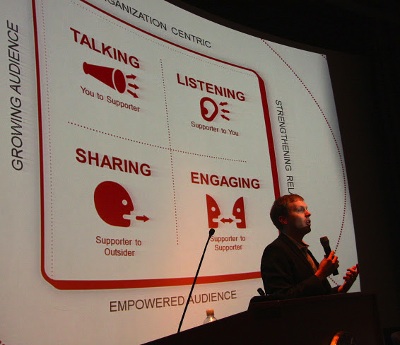
Anthony Shop of Social Driver had some good analogies and PowerPoint slides. Image from prsa-ncc.org.

Metaphors are implied comparisons in which a word or phrase ordinarily used for one thing is applied to another, as in “time is a thief” or “all the world’s a stage.” We hear a lot of business metaphors using sports terms: “the ball’s in your court” or “go out there and hit a home run.”

When I’m listening to speakers at events, I try to jot down the more memorable comparisons and analogies I hear.

Yesterday, I attended a PRSA-NCC workshop on social media featuring Anthony Shop of Social Driver and Christina Gordon of Change the Equation. I didn’t always catch the details of what they said, but I left with some good examples and illustrations.

Here are a few:

Social media is like the telephone (vs. television). Shop made the point that if you view social media as just another channel to push out content (like TV), you are completely missing the point. It’s more like the telephone, which is designed to facilitate a two-way conversation.

Social media is like a campfire (vs. a bullhorn). Gordon’s simile may actually be closer to the mark in describing what happens when social media is working well. Campfires are where you gather to share stories and bond. Social media is definitely a group activity. A bullhorn is like the TV set, just another way of pushing out a message.

Slinky lead-and-follow analogy. Shop used a Slinky to describe the relationship his company has with its clients. At first, he is leading clients with his knowledge of social media and strategy; but like a Slinky going down the steps, the back of the Slinky becomes the front on the next step. This is where the client leads with insights on its products, services and audiences. Then, like the Slinky, Shop’s firm leads again by pushing the client further and in new directions. This dynamic is at work throughout the relationship. Nice analogy!

Shop and Gordon had some good slides as well. And unlike many speakers, they used PowerPoint effectively—not too much information on a slide, with great visuals (instead of all text and too many bullets).

Whenever I do presentation training, I always make the point (all trainers do) that audiences retain very little of what they hear. In fact, it’s disturbingly low what the human brain actually retains. Some people remember as little as 10 percent after just a few days.

You can stretch your audience’s capacity to remember your key points if you use these five tools:

  • Stories
  • Analogies
  • Visuals
  • Examples
  • Repetition

What was that again?

Posted in Communications | Tagged , , , , , , , , , | 1 Comment

5 lessons children can teach us about employee engagement

You’d think that with all of the books, seminars and coaching out there on building winning teams, we’d be doing a better job of engaging employees. But not according to a pair of studies noted in the latest issue of the Strategist, a quarterly magazine of the Public Relations Society of America:

  • A study conducted by Dale Carnegie Training found that just 23 percent of employees below the managerial level are “engaged,” meaning they feel enthusiastic, inspired and confident in their jobs.
  • A Gallup survey found that 70 percent of American workers are either “emotionally disconnected” or “actively disengaged” and therefore less likely to be productive.

“Gallup places the blame for a nation of alienated workers on managers and executives who have never learned basic people skills,” the Strategist reported.

Ouch.

One of the most important jobs a CEO has is to lead and motivate employees. Yet, time after time, we see folks in the C suite stumbling when it comes to basic communication.

Lego pool

Yes, it’s a Lego swimming pool, complete with two lounge chairs. Construction by Jay and Kylie; photo by Debbie Strickland.

I was thinking about this over the weekend as I spent time with Kylie, Debbie’s 6-year-old granddaughter. If you want to learn about engagement, spend some time with kids!

When Miss Kylie was 4, I wrote about the lessons she taught me about SMART goals. Here are some lessons she’s taught me about engagement:

1. Authentic interaction goes a long way. I love getting down on the floor and playing at the same level as kids. This weekend, Kylie and I built a Lego swimming pool. When you allow yourself to enter a child’s world, you truly are engaged. And they know it.

Lesson: You rarely see CEOs connect at the rank-and-file level; but when they do and are able to communicate their vision in plain terms, you know the organization is firing on all cylinders.

2. Learn from everyone, regardless of who they are. I discovered two things about my iPhone from Kylie this weekend: How to take a screen shot of any app you have open and how to play music from iTunes when it’s in a game app. (No more annoying game music!) I learned this from a 6-year-old!

Lesson: Why are managers so unwilling to learn from their subordinates? Their customers? Their vendors? If you are open to new ideas, suggestions and feedback, there is a whole new world of possibilities awaiting you. Some of the best ideas come from those on the front lines.

3. Focus, focus, focus. Kids may have short attention spans, but when they are eating, watching TV or playing a game, they are focused! If you are not equally focused, they will notice.

Lesson: Give your team 100 percent when they need it. When you talk to an employee one-on-one, make eye contact. Don’t be texting or checking emails. Organizations need to stay focused, too. A disengaged employee is an unfocused employee. It’s bad for morale and bad for business.

4. Live in the moment. You score no points for making promises about next time or reminding kids that they already had a cupcake 5 minutes ago. It’s all about the present. The good news is that they don’t hold grudges or let bad thoughts get in the way of enjoying the task at hand. Each moment is lived joyfully, without anxiety or regret.

Lesson: While long-term planning is certainly necessary, it’s the day-to-day hassles that bog us down. Let your team know that you understand what they’re going through. An unexpected compliment, a surprise bagel, a free lunch—start your own mini-traditions that keep work upbeat and lively. It’s contagious, and it can also improve the interactions your staff has with customers.

5. Use your imagination. Children have a tremendous capacity for imagination, curiosity and wonder. You see it in their play, in their questions and in the confidence they have in their world.

Lesson: I like the saying, “You have to dream before your dreams can come true,” attributed to former Indian President Dr. A. P. J. Abdul Kalam. Make it a habit to ask “what if?” questions and stretch when it comes to goal-setting. Give your team permission to think big.

Posted in Leadership, Management | Tagged , , , , , , , , , , , | 4 Comments

On judging people and being a better conversationalist

Beauty and the Beast

How do you judge others? Detail from Walter Crane’s “Beauty and the Beast.” Image from branchcollective.org.

Judging people is a difficult, but necessary part of running a business, managing a team or being a volunteer leader. It’s especially crucial if you are an independent consultant since you are often entrusting your future in partners, vendors and clients that can lead to success or result in headaches and frustration.

I’ve written before about the importance of soft leadership skills, what Daniel Goleman calls emotional intelligence or EQ. His research in the 1990s at nearly 200 large companies led him to conclude that EQ is twice as important as technical skills in determining success. EQ includes self-awareness, motivation, empathy and social skills.

A pair of recent articles about judging people and engaging them in conversation drives home the point that if you’re the one in your organization making people decisions, you really need to flex your EQ muscles.

Anthony K. Tjan posted a helpful piece in June on the HBR Blog called “Becoming a Better Judge of People.” He notes that it’s easy for us to judge people on their “extrinsic markers” such as job title, net worth, or even how many Facebook friends or Twitter followers they have.

But extrinsic credentials only tell one part of a person’s story, Tjan reminds us. “What they miss are the ‘softer’ and more nuanced intrinsic [credentials] that are far more defining of a person’s character. You can teach skills; character and attitude, not so much.”

I like the 10 questions that he suggests you consider when judging a person’s suitability for a task or job. Here are two good ones to remember:

Is this an energy-giver or -taker? There is a certain breed of people who just carry with them and unfortunately spread a negative energy. You know who they are. Alternatively, there are those who consistently carry and share a positivity and optimism towards life. There is a Chinese proverb that says that the best way to get energy is to give it. Energy-givers are compassionate, generous and the type of people with whom you immediately want to spend time.

Is this person likely to “act” or “react” to a task? Some people immediately go into defensive, critical mode when given a new task. Others jump right into action and problem-solving mode. For most jobs, it’s the second kind you want.

Another piece worth looking at is Shane Parrish’s “Ten Techniques for Building Quick Rapport With Anyone” on his Farnam Street blog. (BTW, Farnam Street is a great blog!) Let’s face it, if you’re a lousy conversationalist, you’ll never find out enough about other people to judge whether they are a good fit for your team or project.

Parrish’s post is actually a summary of the book “It’s Not All About ‘Me’” by Robin Dreeke, an instructor at the FBI’s Counterintelligence Training Center in behavioral and interpersonal skills training. So you know there’s some good insight here on mastering interpersonal communication.

Validation, one of the 10 techniques Dreeke recommends, is absolutely crucial to communicating with another person. To me, this is the essence of good conversation, but most people fail to practice it. Here’s an excerpt on validating others from Parrish’s post:

Validate Others

There are many types of validation. Robin identifies three of them.

Listening
This is the simplest and one of the most effective. Just listening to someone can produce amazing results.

True validation coupled with ego suspension means that you have no story to offer, that you are there simply to hear theirs.

And there is another benefit. When the focus is on the other person and we’re not anxious to tell our own story, we also tend to remember the details. We’re mindful.

Thoughtfulness
… few people naturally use this to its fullest potential, and, most of the time, we don’t realize when it is being used; all we know is we really like the person who gives it.

Demonstrating thoughtfulness in words and actions with everyone in our lives is a simple and effective way to improve our relationships.

Validate Thoughts and Opinions
This technique is quite difficult because of “our innate need to correct others and the difficulty we have suppressing our own egos.”

But if you remember that we like people who are like us, you’ll immediately grasp the power of validating the thoughts and opinions of others.

The best way to get someone to do what you want them to do is to have them come up with the idea. The best way to have them come up with your idea is, no surprise, to honestly understand the other person’s point of view and then build upon that base with your ideas.

Posted in Careers, Leadership, Management | Tagged , , , , , , , , , | Leave a comment

Evaluating Vine and other social media

I had lunch last week with my friend and former NAFCU colleague John Zimmerman, who showed me a clever 6-second video he made on Vine—a social media app that has gotten a lot of attention lately but one that I hadn’t yet examined.

Vine

Vine is a hot right now, but will it last?

Just when I thought I had social media under my belt, along comes a new one I need to pay attention to. So I downloaded the app, and I have to admit these little continuous-loop videos can be mesmerizing. But how do I know if Vine, which debuted in January and by June was the #1 download on the App Store, will last?

It often seems with social media that we’re chasing down the latest fads or hoping not to miss out on the next big thing. It reminds me of high school when the details of a party were a closely guarded secret—unless you were one of the cool kids. Nerds like me never seemed to get the word. We just heard about how great the party was on Monday. That seems to be my plight with new social media.

Yet, as much as I want to be hip about cutting-edge technology, I’m skeptical about spending a lot of time on something that may not show any return on investment, make sense for a client or even be around in a few years.

So how do you separate the flash-in-the-pans from the ones that are built to last? How do you evaluate whether a new social media network is right for you or your clients?

Among the basic questions you should ask:

  • Who is using the new media, and do they include your customers or potential customers?
  • What kind of content is being shared, with whom is it shared and how likely are they to influence your target audience?
  • How would you integrate the new media into your current mix of channels? Can you use it to cross-market your content?
  • How much time and resources will it take to invest in the new media and then maintain a consistent presence in that network?
  • Is there a way to measure results? ROI?

For a good checklist on how to evaluate new social media, see “8 Questions to Evaluate if That New Social Network is Worth Your Company’s Time” by Tom Demers.

Here’s some good advice from #7 on Demers’ list:

How much time and resources are required to participate in this social network?

Do you have the time to devote to embracing a new social network? Many business owners or marketing directors are already overworked and adding one more element to the daily grind may just be the proverbial straw that breaks the camel’s back. You also want to avoid spreading yourself too thin. The more networks you belong to, the greater your total investment and the more likely you are to post only sporadic content across each. You’ll achieve a better ROI by selecting a few key networks that are right for you and putting the necessary effort forth to really utilize the full power of social media. Knowing your required investment in advance may make it a little more palatable.

Posted in Marketing, Technology | Tagged , , , | 3 Comments

Protecting your good name in the digital age

From time to time I have tried to help out a small business owner in my neighborhood with marketing ideas and advice. Lately, we have been looking at Yelp and pondering how to mitigate the damage to her reputation from a few bad reviews.

She just wants them removed, pure and simple. Unfortunately, you can’t do that. “But there must be some way to get rid of them!” Well, not completely.

Reputation: what are they saying about you?

Image from internetreputation.com.

As with most social media and the many review sites that rate restaurants, doctors and other service providers, you are generally stuck with the good, bad and ugly.

My friend has many devoted customers, and I have suggested that she encourage them to write good reviews to push down the bad ones. Over time, the bad reviews will fall to the bottom of the list and her ratings will improve.

So far, she is reluctant to ask her customers to do anything. I’ve also suggested that she respond to the negative reviews, which she is entitled to do as the owner of the business. I have even offered to help her write a response since English is not her native language. It is important to take the right approach when responding to online criticism. You don’t want to appear too defensive, condescending or angry. You certainly don’t want things to escalate.

No, she would rather not respond. “Can’t we just shut the whole thing down? Why do I have to be listed on Yelp?” No, you cannot just shut Yelp down.

I have known this person for well over a decade. She is a hard worker and is very dedicated to her business and customers. It can’t be easy for her to see those bad reviews, but few things ever go away on the Internet.

So here are four things you can do (at a minimum) to make sure your name isn’t dragged into the digital mud:

1) Look in the virtual mirror. Get in the habit of checking the search engines to see what pops up under your name. In fact, I would suggest several different searches, especially if you have a common name or are best known in a particular geographic area or industry. Here are some searches to try:

  • Name (or variation on your name with nick name or middle name)
  • Name + city where you live/work
  • Name + zip code
  • Name + industry/key words

You’d be surprised how just changing these filters can make a difference in your searches.

2) Repair the damage you are able to repair. Sometimes you can remove damaging content by sending a request to the owner of the site and asking that it be removed. Or, if you were the author of the content, you may be able to remove or modify it yourself. You can also close accounts that you no longer use.

3) Be proactive in guarding your reputation and building your brand. It takes time, but you can improve your Internet image if it has been tarnished by a bad review or an embarrassing post. Get in the habit of posting positive things about yourself or company. Ask others to give recommendations on your behalf. Don’t just play defense, get out there and engage!

4) Ignorance is not bliss. My friend’s latest stance is to just forget about the bad reviews. But you ignore bad PR at your own peril. You never know who may see a negative post or how it might come back to haunt you. It could be an employer, a client or even your friends. You need to be prepared to explain what happened and be able to say, “I’ve done everything in my power to correct that misperception.” After all, it’s your name.

Posted in Management, Marketing | Tagged , , , , , | Leave a comment

‘Your current circumstance is not your conclusion’

Bible in jail

Image from dailyoffice.org.

I have written before about my involvement in the Kairos prison ministry program. This past weekend, our team from Northern Virginia spent two days at Greensville Correctional Center in southeastern Virginia. In the prison’s gym where we met was a small sign that read: “Your current circumstance is not your conclusion. Your best days are ahead.”

I thought about those words during our weekend with the 70 inmates who participated in our “2-Day,” a refresher course of sorts to recharge batteries and strengthen faith.

It is pretty obvious in prison what your physical circumstances are. You are behind bars, and your every move is monitored and regulated. From the daily “counts” to the times when you can go to chow, leave your cell or walk around the yard, your freedom is limited. But any inmate will tell you that these physical restrictions are the least of his worries.

When inmates open up about their problems, what’s likely to weigh most on their minds are the fears and concerns that burden any man—in prison or on the street. An aging mother who doesn’t have any one to take care of her, missed birthdays of sons and daughters, estranged wives who have stopped visiting, friends and relatives who no longer write, a younger brother who is running with the wrong crowd. There are feelings of anger, loneliness, sadness and regret. In short, the human condition is the human condition, whether you are living in luxury or confined to a small cell.

What impresses me the most each time I go into Greensville is the strength these men exhibit. Nowhere else have I encountered such unshakable faith. That faith, tempered by hardships and life experiences that most of us can’t even imagine, makes these men some of the most sublimely positive and joyful I have ever met.

That is the rub that always confounds and lifts me up: Men who should be weighed down and broken by their poor choices, hard luck and long sentences are instead rays of sunshine and hope.

These are men who know full well that “their circumstance is not their conclusion.” But I think they would beg to differ that their “best days are ahead.” A man who sat at my table over the weekend said he would not trade his prison faith journey for anything in this world. His best days are right now. Why? Because he is able to serve God in a ministry he believes in. And he is wise enough to understand that his faith makes him freer than most men on the other side of the barbed wire.

It’s so easy to complain about our circumstances: “Oh, if I could just be more successful, live in a nicer neighborhood, drive a faster car, lose a few pounds or maybe win the lottery!”

Don’t get me wrong, I believe we should always strive to improve ourselves and grow. But I also believe, as Wayne Dyer so aptly put it: “When you dance, your purpose is not to get to a certain place on the floor. It’s to enjoy each step along the way.”

In the dance of life, we should rejoice in each day that we are alive, in each breath that we are able to breathe. If we can live our days with purpose, who’s to say that they are not our best days?

Posted in Purpose | Tagged , , , , | 10 Comments

Spaces, places and where we live

Good old Gaston Bachelard, the French philosopher who wrote about houses having souls. I was thinking about him recently as I prepared to rent my house to Gordon and Teca, a missionary couple from Brazil, and their family. For four months they will be living in my house, and I will be living in an…undisclosed location. Okay, it’s Debbie’s house.

Gaston Bachelard

Gaston Bachelard, the French philosopher who wrote about the poetics of space. Image from speakmnemosyne on tumblr.com.

I first encountered the writings of Bachelard in 1997 when I was taking a graduate seminar at George Mason University on literature and spaces. We were assigned readings from Bachelard’s “The Poetics of Space,” a 1958 treatise on the phenomenology of houses. Phenomenology is just a fancy word to describe the study of experience or consciousness.

According to “The Cultural Studies Reader,” “The house is, for Bachelard, the quintessential phenomenological object, meaning that this is the place in which the personal experience reaches its epitome. Bachelard sees the house as a sort of initial universe, asserting that ‘all really inhabited space bears the essence of the notion of home.’”

To quote Bachelard:

In the life of a man, the house thrusts aside contingencies, its councils of continuity are unceasing. Without it, man would be a dispersed being. It maintains him through the storms of the heavens and through those of life. It is body and soul. It is the human being’s first world. Before he is “cast into the world,” as claimed by certain hasty metaphysics, man is laid in the cradle of the house…Life begins well, it begins enclosed, protected, all warm in the bosom of the house.

In short, the house is the most intimate of all spaces. It “protects the daydreamer,” and therefore to understand the house is to understand the soul.

To give up my house, then—that space I’ve called my home for the past 15 years and also made into my office—is a pretty heavy phenomenological change!

So much of our psyche is tied up in our feelings about the houses we grew up in and all the houses we have lived in since. Breaking up with them, as the song says, is hard to do.

I remember my professor at George Mason saying that before you move out of a house, you should walk into every room and embrace the house one last time. “What kind of New Age bunk is that,” I thought. But when it came time to sell my house in West Springfield, I deliberately and slowing walked through each room the night before closing and tried my best to embrace it. I have to say, I felt a certain release and closure.

This week, as I’ve adjusted to my new home-away-from-home, a certain “doneness” has settled in. I’ve felt a sense of finality, a feeling of completion, a peaceful calmness. For weeks leading up to my moving out, I rushed to patch, paint and clean. I worried about all those things that go into making a house look presentable.

In my mind, all of that is over, behind me, and now it’s time to move ahead. I feel relief. And, eerily, I do not miss my house—at least not yet.

I am lucky to be sharing a space with someone special, and I guess that helps, too. Let’s hope the blissfulness that Bachelard says we associate with houses lasts!

Posted in Happiness | Tagged , , , , | Leave a comment

Too much information at my local Panera

I love Panera Bread, the bakery, salad, soup and sandwich chain that has great food at reasonable prices. I often go there around midday to grab some lunch, especially if I’ve been working from home and need a little human contact.

The Panera near me in Kingstowne does not disappoint. It’s always teeming with people from all nationalities, demographics and economic strata. It is a smorgasbord of food and humanity.

Panera

Have you ever seen an empty Panera? The one near me in Kingstowne, Va., is always packed. Image from the Architectural Design Guild.

For the longest time, my only pet peeve about Panera was its policy of free Wi-Fi and allowing “customers” to set up shop at the tables and booths. I’m talking about the people who buy one cup of coffee and then spend hours on their laptop with their headphones on, oblivious to real customers trying to find a place to sit. Or they’re on their cell phones making business calls. Excuse me, but isn’t that what an office is for?

Now days, I have a new pet peeve. I call it the Panera Interview. More and more, I’m seeing business people conduct full-scale interviews and meetings in the middle of Panera. Or regular people having conversations that I don’t really need to hear.

If you’ve been to Panera, you know the tables are close together. If you want privacy, if you seek intimacy, if you crave confidentiality, Panera is not the place for you.

Yet, while eating my Greek salad or tomato soup, I have overheard with excruciating clarity:

  • Job interviews so close to my table that several times I’ve felt the urge to pipe up and give the applicant some pointers. At the end of one interview, I wanted to stand up and shake the person’s hand and say, “Good luck!”
  • A meeting of two contractors who were complaining about the lack of direction from the client. Again, I felt an urge to stop by their table and offer some advice.
  • Numerous meetings with clients or potential clients where details of a contract or the scope of work are shared.
  • A heated exchange between a man and woman whom I surmised were getting divorced.
  • An awkward first date between a middle-aged couple.

I myself fell victim to the Panera Interview last fall when an insurance agent suggested that we meet there to discuss some liability coverage. Things were going fine until she started asking me for some personal information to prepare a quote. My God, I thought, I’m being Panera-ed! So for our next meeting, I suggested she stop by my home office.

I can see the reasons why managers might want to interview candidates outside the office. It doesn’t tip off your employees that you’re interviewing or who you’re talking to. It is a neutral setting. And if you’re a job seeker, you don’t have to be out of the office for hours pretending to be somewhere else. You can truthfully say you’re going out to get something to eat.

But in Panera, folks, let’s use a little discretion! And that goes for Starbucks, too. We wish you luck on your interview, but we don’t need to know the names of your children, your hobbies or your work history.

Posted in Careers, Management | Tagged , , , , , | 6 Comments

Brand relevance and the art of finding your sweet spot

Reblogged from The PRSA-NCC Blog

I recently invited D.C. marketing expert Bob London to speak to the Independent Public Relations Alliance. He gave some great pointers on indie branding, which I wrote about in this post for the PRSA-NCC Blog. Enjoy…

“Relevance” is a word that D.C. marketing expert Bob London likes to use when talking to clients or giving branding advice to groups like the Independent Public Relations Alliance.

Bob London speaking

Marketing expert Bob London at June’s IPRA luncheon.

“It sounds simplistic, but in every way, be relevant. Striving for relevance hits all of the touch points of personal branding,” he told a group of about 30 PR practitioners attending last month’s IPRA luncheon in Tysons Corner.

The veteran D.C. marketer is the principal of London, Ink, a firm he started in 1995 to help companies solve business challenges through effective marketing and communications strategies. He often steps in as a “virtual vice president of marketing” to provide interim leadership and execution.

As far as staying relevant, London offered three prescriptions for PR practitioners:

  1. Figure out what you’re great at and make it your brand specialty.
  2. Listen to your clients so you can address their “elevator rants.”
  3. Market yourself through LinkedIn and other social media.

Read more… 436 more words

Posted in Goal setting, Marketing | Tagged , , , , , , | Leave a comment