Give up trying to find your passion and just do it

I was reading Daniel Pink the other day and reflecting on one of his counterintuitive pieces of advice: “Give up trying to find your passion.”

Pink, a top-selling author on career, motivation and work-related issues, is perhaps best known for his book “Drive: The Surprising Truth About What Motivates Us.” About a year ago, he published an e-book called “The Flip Manifesto: 16 Counterintuitive Ideas About Motivation, Innovation and Leadership.”

Flip Manifesto

The premise of “The Flip Manifesto” is pretty simple: Great people and organizations flip conventional wisdom on its head. They take age-old beliefs and turn them upside down. Some of the 16 “flips” Pink describes I’ve heard before such as “Keep a To-Don’t list.” Others would cause any HR manager to go into hysterics: “Pay people too much” or “Take as much vacation as you want whenever you want.”

But Pink demonstrates with studies and examples how each of these counterintuitive ideas makes sense.

Most of my life I’ve grappled with the “passion thing.” As Pink notes, friends, family, mentors and consultants always seem to ask us when we’re in the midst of career crisis, “What’s your passion?”

As if to say, “Listen to your heart, and the path will reveal itself.” Pink says this is nonsense and suggests that we ask instead, “What do you do?”

We’re all used to asking and responding to this simple “what-do-you-do” question. It’s shorthand for tell me where you work or what your job is. But that’s not what Pink is saying.

What Pink means is, “What do you do when you’re not at work? What do you like to do in your spare time? What are your interests?”

“This is how people find their way,” he says after giving several examples of successful people who decided to make careers out of what they did for fun on the side. “Instead of endless self-examination and the search for some inscrutable holy emotional grail, they act.”

Here are some other good “what-do-you-do” kinds questions from Pink:

What did you do last Saturday afternoon—for fun, for yourself?

What books do you read or blogs do you visit, not for work, but just because you’re interested in them?

What are you great at?

What comes easily to you?

What would you do—or are you already doing—for free?

As I near the end of my second year as a self-employed PR consultant, I’ve been thinking about the passion thing in a new light. I’ve begun to see that what I “do” is write.

Writing is a big part of public relations, of course, and it’s that aspect of the business that I always seem to gravitate towards. I guess the fact that I write this blog in my spare time rather than watch TV (or sleep) should be a clue that writing is my “passion.” But I have never thought of it that way. I just think of it as the thing I do.

As Pink says about his own career shift from politics to writing books and magazine articles, “Am I passionate about it? Sure, I guess. Maybe. Some days. But passion isn’t something I much ponder.”


Posted in Careers, Purpose | Tagged , , , , , | Leave a comment

A teachable moment at Home Depot

The sales associate had dreadlocks and was as skinny as a rail. The customer was in her early 70s, short and a little plump. She could have been three times his age. If I weren’t standing in the Nails, Screws & Fasteners aisle of Home Depot, I would have thought I had walked into a career counseling session.

Oak buttons

I didn’t find the wooden screw hole buttons I was looking for, but I found something else at Home Depot. Image from outdoorcraftsmansupply.com.

She was looking for hooks, and he was presumably helping her find them. But in the end, I think she helped him more than he helped her. I was looking for screw hole buttons and couldn’t help but overhear their conversation.

At first I was annoyed. It was late, and I had hoped to zip in and out of the store. I only had two items on my list, but finding things in Home Depot is like trying to find condiments in an unfamiliar grocery store. You can wander up and down aisles in vain, and I had already hit several dead ends in my search for the elusive buttons.

I wanted to ask the young man if the store carried them, but he was too busy talking to the woman. As I waited for them to finish, I began to tune in to what they were saying.

She said she had a house for rent and was doing some repairs. He said his mom also hoped to rent her house. He explained how she had worked hard all her life, sometimes at several jobs, and was close to paying off the mortgage.

He asked the woman how much she charged in rent, where her house was located, what it took to get it ready. She patiently answered his questions and volunteered information about the upgrades that needed to be made to her property. I glanced over at some screws and drywall anchors, trying not to appear too nosy. I heard her say that selling real estate wasn’t easy. Sales don’t just happen, she said. You have to work hard to get them. You need a sphere of influence, a network of people that you can draw on for referrals.

This is good stuff, I thought. Everybody needs to hear this.

Then she asked him what he was doing to save money. Was he putting anything away from his paycheck? Had he opened an IRA? Again, it was the patient voice of experience. She told him how she saved a little bit every year, even when it was hard to do, but that over time her savings had accumulated to over $200,000. That is what she used to buy the house that she was renting.

Work hard, save your money, build a sphere of influence—sound advice for anyone starting out. I wanted to clap.

She turned to me after the young man left, a package of hooks in her hand. “It says they’re stainless steel. Do you think they will rust?” she asked.

“No, they shouldn’t,” I said.

Then she walked off with her package. No rust growing on her, I thought.

I never found those screw hole buttons, but I found something else on Aisle 16 of Home Depot—confirmation that dreams can come true if you are willing to work on them.

Posted in Careers, Getting started, Goal setting | Tagged , , , | 2 Comments

iOS 7 and the end of skeuomorphism

This past week, I learned a new word: skeuomorphism.

A skeuomorph is an object or feature that imitates the design of a similar object made of a different material.

Town & Country

The skeuomorphic Town & Country station wagon.

Faux-leather and simulated woodgrain finishes are skeuomorphs. A classic example is the Chrysler Town & Country station wagon where the side panels appear to be wood but are really metal.

Skeuomorphs have been used extensively in the digital world. Think about how computer apps have been designed to look like their physical counterparts. MP3 players were first designed to look like stereo components. eBook readers mimicked the printed page, and note-taking programs resembled yellow legal pads or Post-its.

Apple’s Steve Jobs was a big fan of skeuomorphs, and he obsessed over getting just the right look and feel to Apple’s designs—calendars with leather stitching, bookshelves with wood veneers, clothbound address books, “docks” with reflective glass borders and windows with brushed-chrome edges.

But last week, with the release of Apple’s new mobile operating system, skeuomorphism was declared dead. Thanks to head Apple designer Jony Ive, iOS 7 is less ornamental, less “fake” than iOS 6. Gone is the heavy embellishment. Instead, we are greeted with a cleaner, brighter, flatter design said to be more focused on function than looks.

As I read the reviews and gathered courage to download iOS 7 for myself, I had mixed feelings about the new design. Now that I’ve used it for nearly a week, I still have mixed feelings.

Skeuomophs have a design purpose beyond ornamentation. They give the user cues, something that was needed in the early days of computers and mobile technology. But now designers tell us that’s no longer necessary, so we don’t need to get bogged down over whether a virtual news stand actually looks like a real news stand. Out with pseudo-physicality, in with digital authenticity.

Voice Memo

Skeuomorphic Voice Memo on the left vs.new iOS 7 version on the right.

Still, I do miss some of those familiar visual cues that gave Apple’s apps a warmer feel. For example, I use the Voice Memo app to record interviews. The old app had a stylized radio microphone, so you could imagine yourself being “on air” when you pushed the record button. It also had an old-fashioned VU meter. The new version replaces the mic and VU meter with a high-tech sound-wave generator. Now I feel like I’m conducting a science experiment rather than an interview.

Ditto for the Notes app, which used to give you a yellow, ruled sheet to write on. Now, it’s just a stark, white screen. That’s a little extreme, if you ask me.

Presumably app developers, who’ve complained about having to spend a lot of time polishing the look of an iPhone app, can now just design good, functional apps. I’m all for that. But I still think there’s room for some creativity, even an occasional nostalgic nod to the world we inhabit.

Perhaps Apple will loosen its design grip at some point and let us pick the “skins” we want for our iPhone apps, much the way Microsoft Media Player users can pick all kinds of cool looks for their virtual boom box. (Dream on, you say?)

Overall, though, I’m impressed with iOS 7. In particular, I like the re-imagined Safari web browser. Finally, Apple has made it easy to navigate between open web pages. You can view and shuffle through them like a stack of cards. I also like the “@” feature in bookmarks, where you can see all of the links in your Twitter feed. Now that is cool.

How ‘bout you? Have you downloaded iOS 7?

Posted in Technology | Tagged , , , , , , , | 5 Comments

Oh, how we love (and hate) our social media

Those of us who use the popular WordPress blogging platform got quite a scare on Wednesday afternoon when, “poof,” all of our followers disappeared in front of our very eyes. I saw it myself. One moment, my followers were listed on my dashboard, the next moment they were AWOL.

Imagine, all three of my followers gone! Okay, I have a few more subscribers than that, enough that I was concerned. Think of those bloggers who have worked for years to build a loyal fan base of thousands of followers. They must have really been sweating.

WordPress

At the time of this post, there were 70.2 million WordPress sites in the world, making it by far the most popular content management system.

As it turns out, the followers really hadn’t disappeared. There was a glitch in the WordPress system, and it was repaired fairly quickly. So no harm, no foul, you might say.

Well, except…

Those few hours of uncertainty made me realize how little control I have over my blog. Actually, how little control we have over social media in general.

WordPress is a free platform. I didn’t pay WordPress anything to deliver this blog to you. Think about other “free” popular social media platforms: Facebook, Twitter, LinkedIn, Pinterest, etc. These media are also available at no cost to content providers and consumers, but all come at a price: little or no control over the medium.

In the good-old days of conventional media, we bought ad space in newspapers and magazines, and time on radio and TV. We rented billboards and signs, and we paid for direct-mail postcards. We carefully controlled the message, timing and duration of our campaigns.

Not so with social media. We’ve ceded control of both the medium and the message. It’s the loss of control over the messaging that has been the hardest and most profound change for us to grasp.

A company spends years carefully building its brand, only to have it tarnished overnight when an inappropriate tweet goes viral. A candidate loses popularity when an ugly comment is captured on YouTube. A job seeker with a great résumé wonders why she didn’t get the position—could it be all those unflattering posts and images on Facebook?

For control freaks, social media is like a bad dream. For those who understand its power, it’s an amazing and liberating gift.

Social media makes me think of the counterculture of the 60s and 70s. The French deconstructionist Jacques Derrida wrote at the time about how social, economic and political structures maintain their power by excluding those who are left out. But he also demonstrated that what is repressed never disappears. It always comes back to unsettle, reverse or topple what has been constructed. In other words, the status quo gets deconstructed.

If this sounds like power politics, in a way it is. Social media can be just as disruptive as a sit-in or protest march. On the other hand, it can be as inane as a stupid pet trick, as adorable as a baby’s first words or as emotional as a 9/11 photo. It’s out there, it’s raw, and it often confounds and amuses us at the same time. But for those willing to ride the wave, it can be an awesome experience.

So WordPress, please don’t unsubscribe my followers. I like it when people can read my stuff.

Posted in Communications, Technology | Tagged , , , , , , , , | Leave a comment

What business are you in? Or how not to be a railroad man

Levitt

Theodore Levitt was a marketing pioneer worth reading.

In his 1960 essay, “Marketing Myopia,” Harvard Business School professor Theodore Levitt famously asked readers to consider what business they were really in.

He argued that the railroads lost their market share (and nearly disappeared) because they incorrectly thought they were in the railroad business instead of the transportation business.

He suggested that Hollywood was losing ground to television because Hollywood myopically thought it was in the movie business rather than the entertainment business.

If you look at the best brands and most innovative companies, they are not really in the business of producing things, at least not in a narrow, utilitarian sense. They are in the business of meeting human needs.

When I think back to the introduction of the iPod, it’s real power lay not in storing and playing back MP3 files but in the way it revolutionized the music industry. iTunes was a game-changer because it pretty much made record companies obsolete. It seems the record companies forgot they were in the music business, not the CD business.

So what business are you in? Whether you work for a large organization or are self-employed, Levitt’s admonition to create satisfaction and value versus products is one worth remembering.

Here are five questions that will help you get at the root of the business you’re really in:

  1. Why do people buy your product or service? Probing deeply into the “why” question may just open your eyes—and present you with new possibilities. Are you truly meeting the needs of your customers? If not, what steps must you take to meet those needs?
  2. Are you the best at what you do? Successful people and companies figure out what they are great at (not just good at) and that’s what they pursue. Being great also means constantly reassessing where you are and what you do, so you don’t find yourself the last producer of slide rules or buggy whips.
  3. Are you willing to innovate and take chances? Levitt says beware of the “belief that there is no competitive substitute for the industry’s major product.” He gives example after example of how this kind of thinking has led to decline. Which brings me to my next point:
  4. Are you mired in incremental change? If this year’s model gets 1.5 miles to the gallon more than last year’s model, ho-hum. Levitt warns against “[p]reoccupation with a product that lends itself to carefully controlled scientific experimentation, improvement and manufacturing cost reduction.” Be willing to make big changes!
  5. Are you paying attention to trends? The reason trends are important is because they show patterns in consumer behavior, and they can point to new markets you should be exploring. Don’t put your head in the sand like the railroad barons of yesteryear and ignore your customers.

Great organizations understand that it’s always about the customer. “In short,” says Levitt, “the organization must learn to think of itself not as producing goods or services but as buying customers, as doing the things that will make people want to do business with it.”

Posted in Leadership, Marketing | Tagged , , , , | Leave a comment

EMV ‘smart’ cards: the next big thing in payments

emv-artwork

What’s in your wallet? EMV credit and debit cards with computer chips are poised to replace mag stripe cards.

An article I wrote on EMV cards just came out in The Federal Credit Union magazine, a publication of the National Association of Federal Credit Unions. So today I’m going to tell you about EMV.

What are EMV cards, you ask? Pull a debit or credit card out of your wallet, and I’ll explain. Notice the dark-brown horizontal stripe on the back? That’s the magnetic stripe used to “swipe” your card at a terminal. EMV cards, also known as “smart” or “chip” cards, have an integrated circuit embedded in them instead.

EMV chips are the next big thing in card technology; they’re impossible to counterfeit, and they’re capable of delivering highly secure transactions. Soon, they’ll replace the mag stripe cards that have been in use for decades.

These chips can also process contactless payments. That’s where you waive your card within close proximity of a terminal, and it processes your transaction (poof, like magic) using NFC or Near Field Communication. The same technology is being developed for smartphones to allow you to use your phone as a mobile wallet.

As cool as this new technology is, migrating to these new cards will be a daunting task. The U.S. has over a billion magnetic stripe cards in circulation, 16 payments networks and 12 million point-of-sale terminals. The Aite Group has estimated the cost of conversion in the billions of dollars.

It’s no wonder that merchants have so far have been reluctant to purchase new EMV terminals. They also have enjoyed a “free ride” when it comes to counterfeit credit card fraud, which is generally absorbed by the card issuers.

But all of this is changing. Beginning in October 2015, the liability for counterfeit card fraud will shift to the merchant or financial institution that doesn’t have an EMV-enabled terminal or card. This liability shift is driving both merchants and financial institutions to begin the great EMV migration.

Credit unions have been early adopters in the EMV space. For credit union members who live or frequently travel abroad, EMV makes a lot of sense. Travelers to Europe have long complained that their mag stripe cards sometimes get rejected at train and airport kiosks where EMV is now the norm. In fact, Europe has used EMV cards for well over a decade.

So for my article, I interviewed United Nations Federal Credit Union, the very first financial institution in the U.S. to roll out an EMV credit card. I also talked to State Department Federal Credit Union, American Airlines Federal Credit Union and Andrews Federal Credit Union, all of whom have rolled out some form of EMV card.

If you want to read more, download a PDF of my article, or visit the digital edition of the September-October 2013 issue of The Federal Credit Union.

By the way, this is the second article I’ve written about technology and credit unions. Last year, I wrote “In the Year 2022,” which describes the future of mobile banking. Now that’s a great piece, too. 🙂

Posted in Technology | Tagged , , , , , , , | Leave a comment

Stop the world, I need to make a decision!

Hamlet

Hamlet was one complicated dude who couldn’t make up his mind. Image from cyborboris.wordpress.com.

Has this ever happened to you?

You finally work up enough nerve to ask someone out, but the person already has a date.

You ponder for days whether to put in for that new job at work, only to find out that someone else is being considered for it.

You see an item on sale but decide to think it over before buying it. When you return, it’s gone.

You read about a new business with the exact same concept you’ve been mulling over for months.

We shouldn’t be shocked when opportunity slips through our fingers, but each time it happens we are. That’s because the whole time we’re agonizing over a decision, turning it over and over in our mind, we think the rest of the world has come to a screeching halt. We think that when we’re ready, life will resume right where we left off. There’s only one problem, life doesn’t have a pause button.

I had a small reminder of that a few days ago. I’ve been thinking about making some design changes to The Wayward Journey. After all, it’s been two years since I first tinkered with the current design. I figure it’s time for a new look.

You can see the design I really like on Tim Brown’s blog, Design Thinking. He is the president and CEO of IDEO and the author of “Change By Design.” Ever since I discovered his blog, I’ve admired its clean look. Yeah, it’s words with a photo, just like mine, but they look so much better on his blog.

8bit

Say it ain’t so! The 8BIT team is calling it quits.

I got really excited when I learned that the WordPress theme he uses is available for purchase from a team of developers called 8BIT. I thought, this is it! When I’m ready to upgrade The Wayward Journey, I’ll go to the 8BIT site and buy the theme.

That was in December. So what do you suppose I found out when I went to download the theme on Tuesday?

The company is going out of business! How could they do this to me when I was SO close to making my decision?

In a farewell message posted on its website, 8BIT recommends that users consider two other well-known WordPress partners: WooThemes and StudioPress. I am familiar with both of them; in fact, my JMC website is built on the Agency StudioPress theme. I don’t want StudioPress. I don’t want WooThemes. I want 8BIT!

But as John Saddington, 8BIT’s lead developer, wrote in his blog, “There’s only one real guarantee in this life (besides death and taxes, of course)—and that’s change. It happens to all organizations of all sizes, it occurs for every product big and small.”

So don’t be a Hamlet. No one ever got ahead by putting life on hold.

Posted in Communications, Technology | Tagged , , , , , , , , | Leave a comment

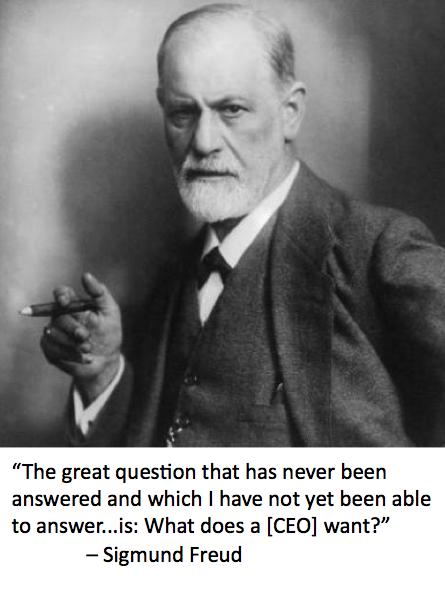
What does a CEO want?

FreudIt seems that we are always guessing what CEOs want. Even the Mentalist would be hard-pressed to figure out some of the inscrutable things they say.

“Transparency” may have climbed to the top of most organizations’ list of core values, but CEOs remain difficult to read. What do they see that we don’t? What keeps them up at night?

A couple of weeks ago, I wrote about a PRSA-NCC workshop I attended on social media. Presenter Anthony Shop of Social Driver mentioned a Conference Board survey of CEOs that ranked what global business leaders are concerned about these days.

That piqued my interest, so I decided to track down the survey and take a closer look. It’s a pretty darn good snapshot of what’s on the minds of CEOs. It may not explain everything your CEO is thinking about, but it could help you strike up a conversation the next time you see her in the lunchroom or get stuck with him on the elevator.

So here are the Cliff Notes of this year’s Conference Board CEO challenges. Below are the top four challenges, followed by the top five strategies CEOs said they will employ to meet those challenges.

I think you will see an interesting pattern. If there is a theme song this year, it might be “People” from the Broadway musical “Funny Girl.”

1) Human Capital

  1. Grow talent internally
  2. Provide employee training and development
  3. Raise employee engagement
  4. Improve performance management processes and accountability
  5. Increase efforts to retain critical talent

2) Operational excellence

  1. Raise employee engagement and productivity
  2. Focus on reduction of baseline costs
  3. Break down internal silos
  4. Continual improvement (six sigma, total quality, etc.)
  5. Seek better alignment between strategy, objectives and organizational capabilities

3) Innovation

  1. Apply new technologies (product, process, information, etc.)
  2. Engage in strategic alliances with customers, suppliers and/or other business partners
  3. Find, engage and incentivize key talent for innovation
  4. Create culture of innovation by promoting and rewarding entrepreneurship and risk taking
  5. Develop innovation skills for all employees

4) Customer relationships

  1. Enhance quality of products/services
  2. Sharpen understanding of customer/client needs
  3. Engage personally with key customer/clients
  4. Increase speed of products and services to market
  5. Use competitive intelligence to better understand customer/client needs
Posted in Leadership, Management, Organization | Tagged , , , , , , , , | 2 Comments

Don’t be a ‘dunce’ when it comes to blogging

Imagine that you’ve written what might well be the next great American novel. You submit it to Simon & Schuster, and they seem interested. They ask you for some rewrites, but ultimately they drop it. Your novel languishes.

That is, until your mother takes an interest in it.

Thelma Toole

Thelma Toole, the mom who made it happen. Image from Associated Press.

Two years after your death (did I mention you committed suicide?), your mom finds a copy of the original manuscript on top of an armoire. Over the next five years, she sends it to seven publishers, all of whom reject it. Then she gets it into her head to ask the great Southern writer Walker Percy to read it, convinced that he will see the genius of your work.

She starts writing and calling Percy, but he doesn’t answer her letters or take her calls. One day, she bursts into his office at Loyola University of New Orleans and demands that he read it. Percy does, mainly to get her out of his office.

Percy loves it and agrees that it should be published. But he can’t get any of the big publishing houses interested in it either. Three years go by, but finally he convinces Louisiana State University Press to publish it.

You might think that’s the end of the story. Maybe a few LSU professors like it and order it for their classes. Maybe it develops a small following. But it never becomes much more than a curiosity, a testament to your mother’s persistence and a famous writer’s clout.

You’d be wrong because the year after its publication (and 12 years after your death), “A Confederacy of Dunces” wins the Pulitzer Prize for Fiction. It sells over 1.5 million copies and is translated into 22 languages. Your critically acclaimed novel becomes required reading in English classes around the globe, a modern masterpiece.

A Confederacy of Dunces

I sometimes wonder what might have happened if John Kennedy Toole had lived. Would someone else have discovered him? Would we be reading his novel today?

The title of Toole’s novel refers to a line in a Jonathan Swift essay: “When a true genius appears in the world, you may know him by this sign, that the dunces are all in confederacy against him.”

It does seem that a confederacy of dunces conspired against the book’s publication, but in reality a lot of good writing goes unnoticed. It doesn’t have champions like Thelma Toole and Walker Percy.

Every time I push the “publish” button on one of my blog posts, I realize that there’s no guarantee that anyone will read it. It’s not enough to just publish your blog, you need someone to champion it.

You hear a lot about search engine optimization, but it all boils down to getting people interested enough in your work that they truly want to share it with others. The best blogs, like the best brands, are the ones that are championed by their readers and customers.

So the next time someone in your organization complains that no one’s reading the company blog, ask yourself three questions:

  1. Is it good enough that I would want to read it?
  2. Is it good enough that I would want to share it?
  3. And if it is, what have I done to spread the word through my own social media networks and friends?

Don’t be a “dunce” when it comes to blogging.

Posted in Careers, Communications, Marketing | Tagged , , , , , | Leave a comment